Bulldozed Three Times, Rebuilt in the Dark: The Hill of Crosses
GeisTrack Editorial · 31 July 2026 · 5 min read
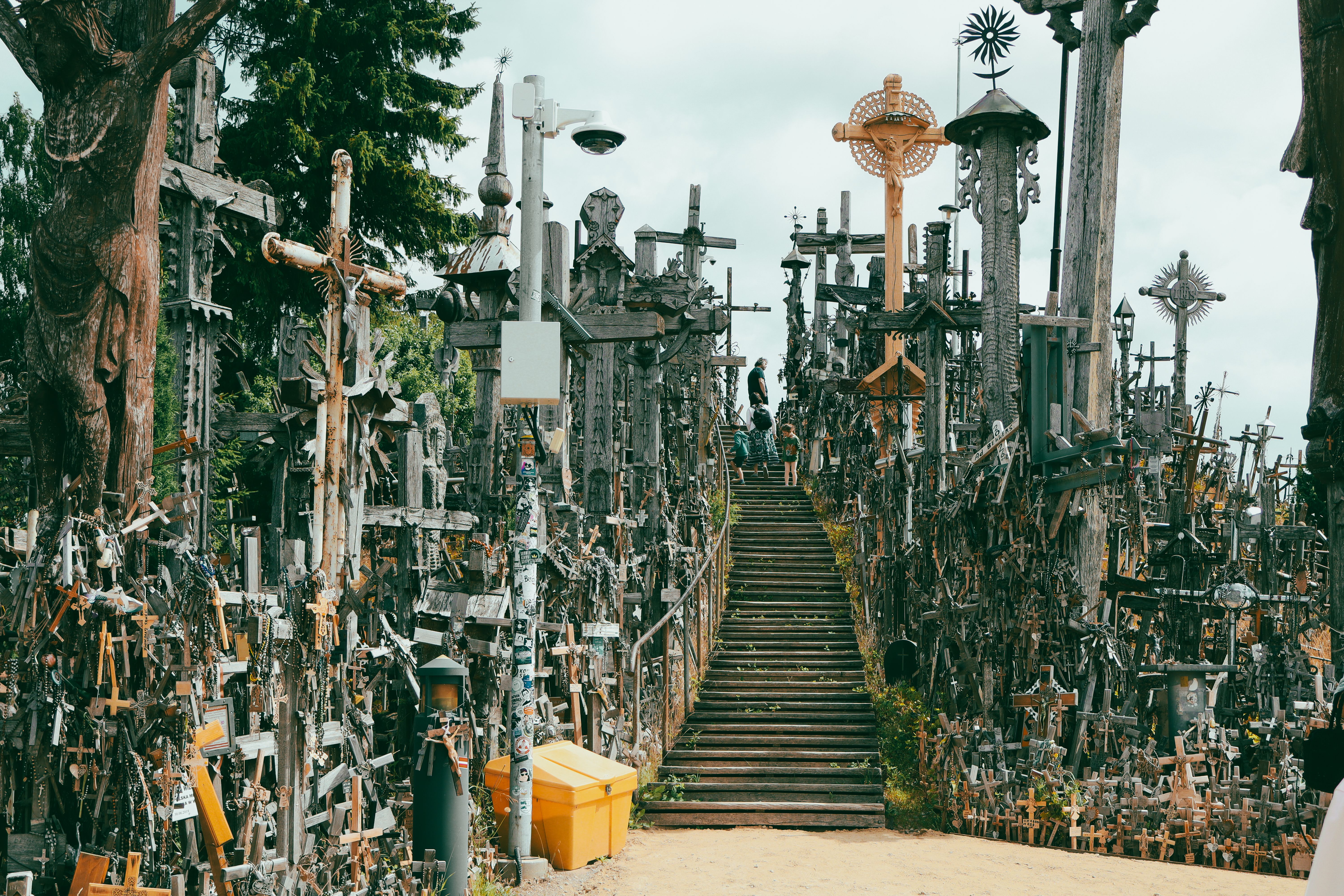
The KGB crushed it with tractors and declared it gone. But each time, the crosses reappeared within days. Nobody ever admitted to putting them there.
It's not really a hill, but more like a gentle rise in a flat Lithuanian field, about twelve kilometers north of Šiauliai. From the parking lot, it looks like a low, gray thicket of bushes. But as you get closer, you'll see what that thicket is made of, and then you'll hear it: thousands of small crosses and rosaries gently knocking together in the wind, sounding like rain on a tin roof.
Nobody knows the exact date when the first cross was placed here. But crosses began appearing after the failed uprising against Russian rule in 1831. Families of those who were executed or sent away to distant lands had no graves to visit, so they put up a cross here instead. This tradition continued, and by 1900, there were about 130 crosses. By 1940, that number had grown to over four hundred.
Then came the Soviet occupation, and this site transformed entirely. It became a place where a country that wasn't allowed to speak freely could say everything, in wood. Between 1961 and 1985, the authorities cleared the hill at least four times. Bulldozers moved in, metal crosses were taken for scrap, wooden ones were burned, and the area was sealed off. At one point, they even tried to flood it with sewage. Yet, each time, people walked out at night across the fields, hiding crosses under their coats, and put them back. By the time Lithuania declared its independence in 1990, the Soviet secret police (KGB) had completely lost this silent battle.
Today, estimates suggest there are well over 100,000 crosses here, and probably several times that if you count the tiny rosaries hanging from the larger ones. Pope John Paul II even held a Mass here in 1993 and left his own crucifix. A Franciscan hermitage, a small religious retreat, was built nearby following his suggestion. You can buy a cross at the kiosk and add it yourself, which is truly the main idea here — this isn't just a monument to look at, it's one you become a part of.
Spend about an hour exploring. Instead of just walking around the edge, take the narrow paths that wind through the middle. You'll want to read the inscriptions: you'll find messages in Lithuanian, Polish, German, English, and Japanese. There are names of people who were deported, names of the recently deceased, wedding dates, and even apologies.
Šiauliai is about two and a half hours from Vilnius by car. It’s easy to combine a visit here with a trip to the Baltic coast at Klaipėda or the unique Curonian Spit. Try to come at dawn or in the last hour of daylight, especially on a windy autumn day, when hardly anyone else is around and the whole hill seems to speak to you.
Plan the trip
Book this journey
We may earn a commission from these partner links, at no extra cost to you.
Visit the place
Practical details, mystery rating and how to plan the trip.