Hill of Crosses
Šiauliai, Šiauliai County, Lithuania19th century
Mystery rating
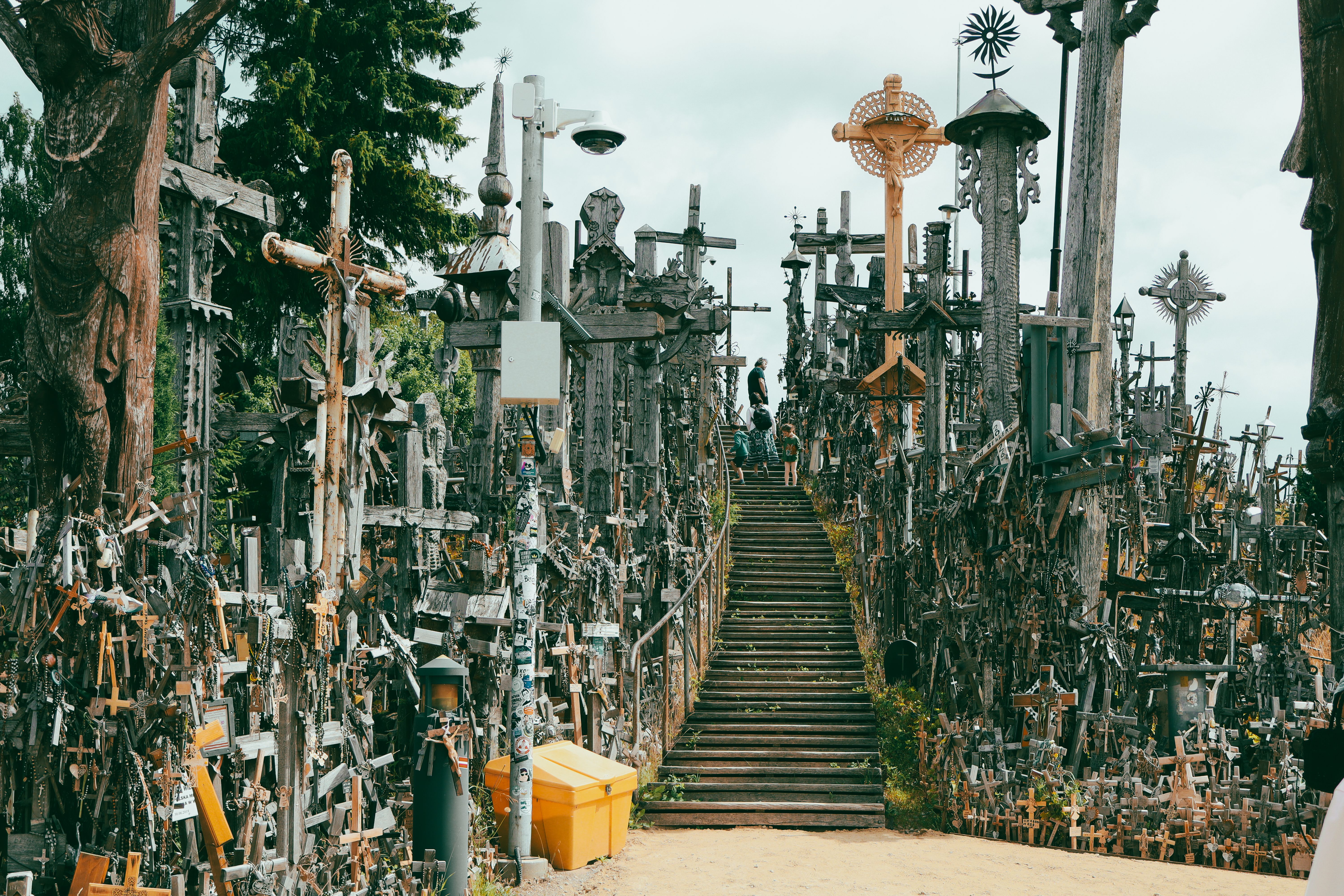
The Hill of Crosses stands north of Šiauliai in Lithuania. It is a small mound covered with more than 100,000 crosses, left by ordinary people over about 200 years. Soviet authorities bulldozed it several times. Each time, people put the crosses back.
Why GeisTrack picked it
GeisTrack includes the Hill of Crosses because it's a rare case where the documented history, not any supernatural claim, is the genuinely remarkable part. Three separate demolitions and three separate rebuilds, driven entirely by ordinary people risking punishment, make this one of Europe's clearer examples of quiet, sustained resistance.
Why it's famous
The first crosses appeared here after an 1831 uprising against Russian imperial rule, planted by families who had no bodies to bury. More followed after an 1863 rebellion, and by 1940 around 400 crosses stood on the hill. After the Soviet occupation began deporting Lithuanians to Siberia from 1944 onward, planting a cross became one of the few ways people could express both Catholic faith and national identity under a regime that suppressed both. Soviet authorities demolished the site three times — 1961, 1973 and 1975 — burning wood, melting metal, and burying broken stone crosses. Each time, new crosses appeared within days, planted secretly at night. Since Lithuania's independence in 1990, the collection has grown dramatically, and Pope John Paul II visited in 1993, calling it a place of hope and peace. A Franciscan monastery was built beside the hill in 2000 on land donated by the Pope, and the site is now being considered for UNESCO World Heritage status.
History
The very first crosses appeared here after a failed uprising against Russian imperial rule in 1831. Families who couldn't find their loved ones' bodies planted crosses here as a memorial instead. More crosses were added after another rebellion in 1863. By 1900, the hill held about 130 crosses, and by 1940, that number had grown to roughly 400. Then came the Soviet occupation. After 1944, thousands of Lithuanians were deported to Siberia. This gave countless families a heartbreaking reason to plant a cross for someone who had been taken away. Planting crosses became one of the few ways people could express both their Catholic faith and their national identity, both of which the Soviet state tried to suppress. The Soviet regime reacted harshly. In 1961, bulldozers cleared the site, burning wooden crosses, selling metal ones for scrap, and breaking up stone crosses to bury them. The hill was leveled again in 1973 and 1975. At one point, authorities even considered damming a nearby river to flood the entire site. But each time, new crosses mysteriously appeared within days, planted secretly at night by brave individuals who risked their safety. After Lithuania regained its independence in 1990, the number of crosses exploded. A Franciscan monastery was built next to the hill in 2000 on land donated by the Pope. Today, the Hill of Crosses is a powerful national symbol and is being considered for UNESCO World Heritage listing.
The full story
You'll find this extraordinary hill just 12 kilometers north of Šiauliai. It's an easy drive off the main highway towards Riga, taking about fifteen minutes by car, or you can take a local bus and enjoy a pleasant two-kilometer walk. Once you arrive, a paved path leads you from the car park across a flat field. Ahead, the mound slowly rises into view. It's not a huge mountain, maybe ten meters high, but it's completely covered with crosses, a truly unforgettable sight. Follow the central stairway up, then wander onto the side paths. The crosses are stacked so tightly in some areas that you'll feel like you're walking through a tunnel made of them. You'll see beautifully carved Lithuanian folk crosses with ancient sun symbols, simple wooden planks with names and dates, Ukrainian tridents, military insignia, and even wedding rings. Thousands upon thousands of rosaries hang everywhere. Take your time to read them. This isn't just an abstract monument; it represents countless personal stories of grief and gratitude. If you feel moved to leave your own cross, you can buy one at the entrance. But many people find that a homemade cross holds a special meaning. There's no admission fee, and the site is always open, day or night. For the most powerful experience, try to visit at dawn, dusk, or when the weather is a bit dramatic. Mid-morning often brings large tour groups from cruise ships. But imagine it at 7 AM in an autumn mist, with only the gentle chiming of the crosses and perhaps a few Franciscan monks nearby – it’s truly transformative. Winter, with snow dusting the crosses, is equally moving. Allow at least an hour to truly absorb the atmosphere. After your visit, you can explore Šiauliai, which has some quirky museums like its bicycle and cat museums. Riga is only two hours north, and Rundāle Palace, often called the Latvian Versailles, is perfectly located between the two. Most travelers rush through the hill in twenty minutes, but trust us, you'll want more time.
Legends & sightings
Local people often describe the hill using words of miracles and faith. The oldest story tells of a heartbroken father whose daughter was gravely ill. A mysterious figure appeared to him, instructing him to carve a cross and take it to the hill. When the father returned home, his daughter was miraculously walking again. Another belief suggests that anyone who leaves a cross on the hill will have their wish granted. This tradition helps explain why pilgrims from distant places like Poland, Ireland, Mexico, and the Philippines continue to add their crosses to the ever-growing collection. The stories from the Soviet era are perhaps the most compelling tales locals share. They speak of crosses reappearing overnight, faster than the KGB could remove them. There are accounts of a carpenter in Šiauliai who always kept a workshop full of ready-made crosses, and farmers walking through dark fields with a hidden cross under their coats, determined to add it to the hill. Many visitors describe an unusual, very specific sound on the hill. Thousands of small rosaries and metal crucifixes brush against each other in the breeze, creating a constant, faint chiming sound that echoes across the entire mound. In the fog, when you're almost alone, it's one of the most haunting and moving sounds you'll hear in Europe.
Fact or legend?
Documented: crosses were first placed here in the 1830s, after uprisings against Russian rule. The Soviet authorities destroyed the site at least three times between 1961 and 1975, and people rebuilt it in secret. Pope John Paul II visited in 1993. Not a legend: the site is entirely real and still growing. Anyone can add a cross. Meaning: it is a place of faith, mourning and national identity, not a paranormal site.
Field notes
- The hill holds an estimated 100,000+ crosses, and nobody has ever completed an accurate count.
- Soviet authorities bulldozed the site in 1961, 1973 and 1975; each time it was rebuilt within days.
- The first crosses commemorated rebels killed in the 1831 uprising against Russian rule.
- Pope John Paul II visited in 1993 and later donated a crucifix that stands on the hill.
- Thousands of small rosaries chiming in the wind give the site a constant faint metallic sound.
- Entry is free and the site is open day and night, all year.
Our verdict
GeisTrack Verdict
There's no ghost story attached to this site, and it doesn't need one. What you get instead is a landscape shaped by real political history: repression, deportation, and defiance, expressed through an object as simple as a wooden cross. Visit at dawn or dusk if you can, since mid-morning brings cruise-tour crowds that flatten the atmosphere considerably. It suits travellers interested in 20th-century Eastern European history more than typical dark-tourism seekers. Most people plan twenty minutes and end up staying an hour. It's free, always open, and easy to combine with a stop in Riga or at Rundāle Palace.
Editorial assessment based on research, not a sponsored review. See our editorial policy.
Can you visit?
Yes. The Hill of Crosses is open to everyone, free of charge, all year round. There is a car park, a small shop selling crosses and a visitor point. You may add your own cross. There is no ticket and no closing gate.
How to get there
1. Fly into Vilnius (VNO), Kaunas (KUN) or Riga (RIX). 2. Travel to Šiauliai by train or long distance bus. 3. From Šiauliai the hill lies about 12 km north. Take a taxi, a local bus towards Joniškis and then walk, or drive. A hire car is the easiest option, and the site is signed from the main road.
Before you go
It is exposed, so bring a coat and waterproofs in most seasons. There is a short boardwalk and gravel paths, so wear practical shoes. Buy a cross at the stall if you want to add one, rather than taking material from the site. Early morning or evening is quiet and far more powerful than midday. Facilities are limited to the small visitor building.
Travel tips
For a truly personal experience, aim to visit at sunrise or dusk; you'll likely have the mound almost to yourself. Consider bringing your own cross or buying one there to add to the collection. Wear sturdy boots, as the side paths can get muddy after rain. If you're heading towards Riga, you can easily combine your visit with Rundāle Palace. And remember, allow more time than the typical twenty minutes most tours offer – you'll want to linger.
Safety
Be mindful of the narrow paths between the crosses; some of them have sharp edges. Please remember that this is an active devotional site, so respect its sacred nature.
What to expect
You walk up a path from the car park and the hill appears suddenly, packed with crosses of every size, rosaries hanging between them and small figures of saints. It is only a few hundred metres of walking. Most people stay 30 to 60 minutes. The sound of rosaries moving in the wind is what visitors mention most.
Visit with respect
This is a place of prayer and remembrance for many families. Dress respectfully, do not climb on the crosses and do not move or take anything.
Frequently asked
Plan your trip
Book the practical parts of the journey. We may earn a commission from these partner links, at no extra cost to you.
Plan your visit
Getting to Hill of Crosses
Everything you need to turn this mystery into a trip. We may earn a commission from these partner links, at no extra cost to you.
- Best time to visit
- You can visit any time of year. However, the autumn mist and winter snow create the most striking and atmospheric scenes.
- Opening hours
- Open at all times
- Entrance fee
- Free
Read the story
Long-form journal writing about Hill of Crosses.
Rate This Destination
What do you think of this destination? Share your rating with the GeisTrack community.
Community Rating
No ratings yet. Be the first to rate this destination.
Visitor opinion only — separate from the GeisTrack editorial mystery ratings above.
Been here? Share your experience
Have you visited this place? Tell other GeisTrack travelers what it was really like. Your experience may help someone plan their own visit.
No comments yet
No traveler comments yet. Be the first to share your thoughts.