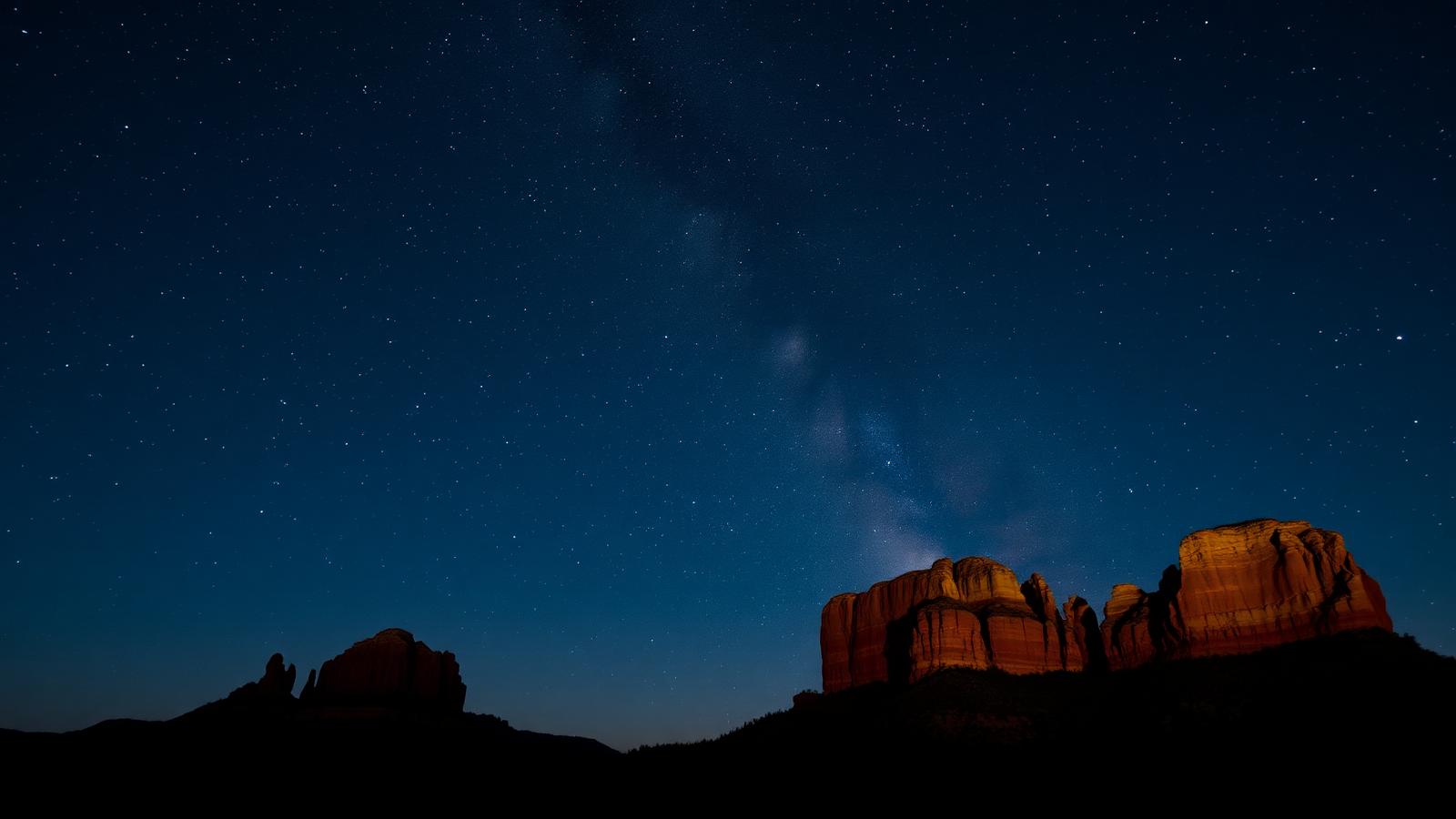
Sedona's Airport Mesa
Sedona, Arizona, United States20th century
Mystery rating
Airport Mesa is a flat topped ridge above Sedona, Arizona, with red rock views in every direction. It is one of the places local guides call an energy vortex, and it is also one of the best sunset and stargazing spots in the area.
Why GeisTrack picked it
Sedona stands out because the mystery here is genuinely optional. Its dark-sky infrastructure, clear desert air, and honest tour guides create a place where you can enjoy excellent stargazing regardless of your views on UFOs, while the small residue of unexplained sightings gives it a real hook.
Why it's famous
Sedona became an International Dark Sky Community in 2014 after adopting strict lighting rules, and the results are dramatic: the Milky Way is often visible from an ordinary parking lot in town. Airport Mesa, a short drive up a narrow road, sits about 500 feet above the valley floor and has become the area's best-known viewpoint, popular with photographers and vortex believers alike. UFO reports in the Verde Valley date to the 1940s and 1950s, long before Sedona's rise as a New Age destination in the 1980s built around four claimed energy vortex sites, including Airport Mesa. Commercial night-vision tours, running since the 2010s, use Gen-3 goggles that reveal dozens of satellites and meteors on a typical night, alongside guides who openly identify most lights as Starlink trains or Iridium flares. What's left unexplained, by the tour operators' own estimate, appears roughly one night in five.
History
Sedona first gained attention as a community for artists and a backdrop for films in the mid-20th century. By the 1980s, it transformed into a major hub for New Age tourism, centered around four sites believed to be energy vortexes. Reports of UFOs in the Verde Valley area date back to the 1940s. The city was officially named an International Dark Sky Community in 2014, and commercial night-vision sky tours have been offered here since the 2010s.
The full story
Nestled in central Arizona, Sedona sits in a natural basin surrounded by Permian sandstone formations. These vibrant red rocks are the first thing that catches your eye. Iconic landmarks like Cathedral Rock, Bell Rock, and Courthouse Butte glow a deep orange as the sun sets, then gradually disappear into the night sky. But for anyone keen on stargazing, what happens next is truly captivating. Sedona has been recognized as an International Dark Sky Community since 2014, thanks to its strict lighting rules. Streetlights are carefully shielded, shop signs are dimmed, and the result is incredible: you can often see the Milky Way clearly from a regular parking lot right in town. Airport Mesa is a classic spot for taking in these views. A narrow road winds its way up to a flat ridge, home to a small airport and a popular viewpoint at its western end, offering panoramic vistas of the entire valley. It’s just a fifteen-minute drive from the town center and sits about 500 feet higher, which is exactly enough to get away from any lingering ground light. On any clear night, you’ll find others there too: photographers with their tripods, visitors drawn to the area's energy vortexes, and at least one commercial group handing out powerful night-vision goggles. Those night-vision tours are a big reason why Sedona often appears on lists of UFO hotspots. These guided sky-watching trips have been operating here for over ten years, and they completely change how we think about a sighting. Through their high-tech Gen-3 goggles, you'll spot dozens of satellites and meteors almost every night. Then there are the objects the guides simply call “unknowns”: lights that stop, reverse direction, or suddenly get brighter in ways no satellite ever would. The tours are also refreshingly honest about the vast majority of what you see – they’ll tell you which passing light is a Starlink satellite train and which is an Iridium flare. What’s left, perhaps one night out of five, is the truly mysterious stuff that keeps people coming back. UFO sightings here actually began long before these tours. Reports from the Verde Valley date back to the 1940s and 1950s. The region has always been open to such ideas; Sedona was a popular New Age hub for decades before it became known for UFOs. Its four famous energy vortex sites, including Airport Mesa, have been drawing visitors since the 1980s. Skeptics might see this as a cycle where belief feeds itself, and they have a point. But this cycle doesn't create the incredibly dark skies, the crystal-clear desert air at 4,200 feet (1,300 meters), or the military airspace that stretches to the northeast. When it comes to practicality, Sedona is arguably the easiest place on any UFO hotspot list to visit. You’ll find hotels for every budget, restaurants open late, and it’s only a two-hour drive from Phoenix. Plus, the daytime hiking here is fantastic on its own. You can bring friends or family who aren't even interested in UFOs, and they’ll still have a wonderful weekend. Very few other places on our map can offer that kind of appeal.
Legends & sightings
Airport Mesa is one of Sedona's four recognized vortex sites, believed to concentrate a unique energy that some visitors link to the frequent aerial sightings. Local stories also suggest a connection between the sightings and a supposed underground base hidden beneath the Mogollon Rim.
Fact or legend?
Documented: Sedona sits in an area of protected dark skies, and the views and geology are exactly as described. The vortex idea became popular in the 1980s New Age movement. Claims: many visitors describe feeling energy, calm or tingling at the vortex sites. Those are personal experiences. No measurement has ever shown anything unusual here. Sky reports: Sedona has a long record of light sightings. Dark skies, aircraft and satellites explain many of them, but not all reports are resolved.
Field notes
- Sedona has been an International Dark Sky Community since 2014, with a city lighting ordinance restricting brightness and requiring shielded fixtures.
- Airport Mesa sits roughly 150 metres above the town centre and is reachable by car in fifteen minutes.
- Commercial night-vision UFO tours have run nightly in Sedona for more than a decade.
- The surrounding red rock is Permian sandstone laid down roughly 270 million years ago.
- Sedona sits at about 1,300 metres, giving noticeably clearer air than the Phoenix basin two hours south.
Our verdict
GeisTrack Verdict
Sedona is the easiest UFO destination on any list to actually plan a trip around. It has hotels for every budget, a two-hour drive from Phoenix, and daytime hiking strong enough to satisfy travel companions who couldn't care less about the sky. The night-vision tours are worth doing once, mainly because the guides are refreshingly candid about what most lights actually are. Don't expect a dramatic encounter; expect a genuinely dark sky, good company, and maybe one unexplained light out of several nights. This suits couples, families, and casual stargazers far better than committed UFO researchers looking for hard evidence.
Editorial assessment based on research, not a sponsored review. See our editorial policy.
Can you visit?
Yes. Airport Mesa is public land with a small parking area, a short vortex trail and a separate scenic overlook with a paid parking lot. It is open to everyone. Parking is very limited and fills up before sunset.
How to get there
1. Fly into Phoenix Sky Harbor (PHX) or Flagstaff (FLG). 2. Drive north from Phoenix on I-17, roughly two hours, then west into Sedona. 3. In Sedona, take Airport Road up the hill. 4. Park at the small pull off for the vortex trail or continue to the overlook. Sedona has a seasonal shuttle for some trailheads, which is worth checking in busy periods.
Before you go
Arrive well before sunset to get a parking space. Bring water and sun protection. Arizona sun is strong even in winter. Wear shoes with grip. The rock is smooth and steep in places. Nights get cold in the desert, so bring a layer if you stay for stars. Check the Red Rock parking pass rules for the lot you use.
Travel tips
On your first evening, consider booking a night-vision tour; it will help you recognize what normal aircraft look like. Afterward, you can revisit Airport Mesa or Boynton Pass on your own. Try to avoid the three nights before or after a full moon, as the extra light will diminish your view. Also, combine your trip with a sunrise hike at Cathedral Rock – it’s best experienced before the crowds arrive.
Safety
The access road to Airport Mesa is narrow, has a steep drop-off, and no lighting, so drive slowly after dark. Desert nights can get much colder than daytime temperatures, so always bring a warm layer, even in summer. Make sure to stay on marked trails at the overlook, as the edge of the mesa isn't fenced.
What to expect
A short but steep scramble up the small hill gives 360 degree views over the red rocks. It is popular, so expect other people at sunset, sometimes with drums or meditation groups. The overlook further along the road is easier and just as scenic. Thirty minutes to a couple of hours, depending on how long you sit.
Visit with respect
Some visitors treat these sites as sacred, and the wider landscape is important to local Native American communities. Keep noise down, stay on trails and take everything out with you.
Frequently asked
Plan your trip
Book the practical parts of the journey. We may earn a commission from these partner links, at no extra cost to you.
Plan your visit
Getting to Sedona's Airport Mesa
Everything you need to turn this mystery into a trip. We may earn a commission from these partner links, at no extra cost to you.
- Best time to visit
- The best times to visit are from March to May and September to November. Summer often brings monsoon clouds in the afternoons, while winter nights are cold but exceptionally clear.
- Opening hours
- Airport Mesa viewpoint open daily; paid parking at the overlook
- Entrance fee
- Free; small parking fee at the Airport Mesa overlook. Tours priced separately.
Continue your GeisTrack
Other places on GeisTrack that pair well with Sedona's Airport Mesa — same kind of story, or the same corner of the map.
Make it a route
Sedona works as a base: Airport Mesa, Cathedral Rock, Boynton Canyon and a day trip to the Grand Canyon.
United States
Roswell
In July 1947 something crashed on a ranch outside Roswell, New Mexico. The local air base first told newspapers it had recovered a flying disc, then said it was a weather balloon. That one day turned a quiet farming town into the centre of UFO culture.
Australia
Wycliffe Well
Wycliffe Well is a roadhouse on the Stuart Highway in Australia's Northern Territory, hundreds of kilometres from anywhere. It calls itself the UFO capital of Australia, and the walls are covered in painted aliens and newspaper cuttings of sighting reports.
Japan
Hakui & the Cosmo Isle Coast
Hakui is a small city on the Sea of Japan coast that calls itself Japan's UFO town. It has a serious space museum with real spacecraft hardware, and local records of strange flying objects that go back to the Edo period, long before modern UFO stories began.
United States
The Stanley Hotel
The Stanley Hotel opened in 1909 in Estes Park, Colorado, at the entrance to Rocky Mountain National Park. Stephen King stayed one night in 1974, in room 217, and the visit gave him the idea for The Shining. The hotel now runs ghost tours all year.
Or browse every ufo alien sites entry, or open the interactive atlas.
Read the story
Long-form journal writing about Sedona's Airport Mesa.
Rate This Destination
What do you think of this destination? Share your rating with the GeisTrack community.
Community Rating
No ratings yet. Be the first to rate this destination.
Visitor opinion only — separate from the GeisTrack editorial mystery ratings above.
Been here? Share your experience
Have you visited this place? Tell other GeisTrack travelers what it was really like. Your experience may help someone plan their own visit.
No comments yet
No traveler comments yet. Be the first to share your thoughts.