The Magic Bus Is Gone: What Happened to Bus 142
GeisTrack · 10 August 2026 · 7 min read
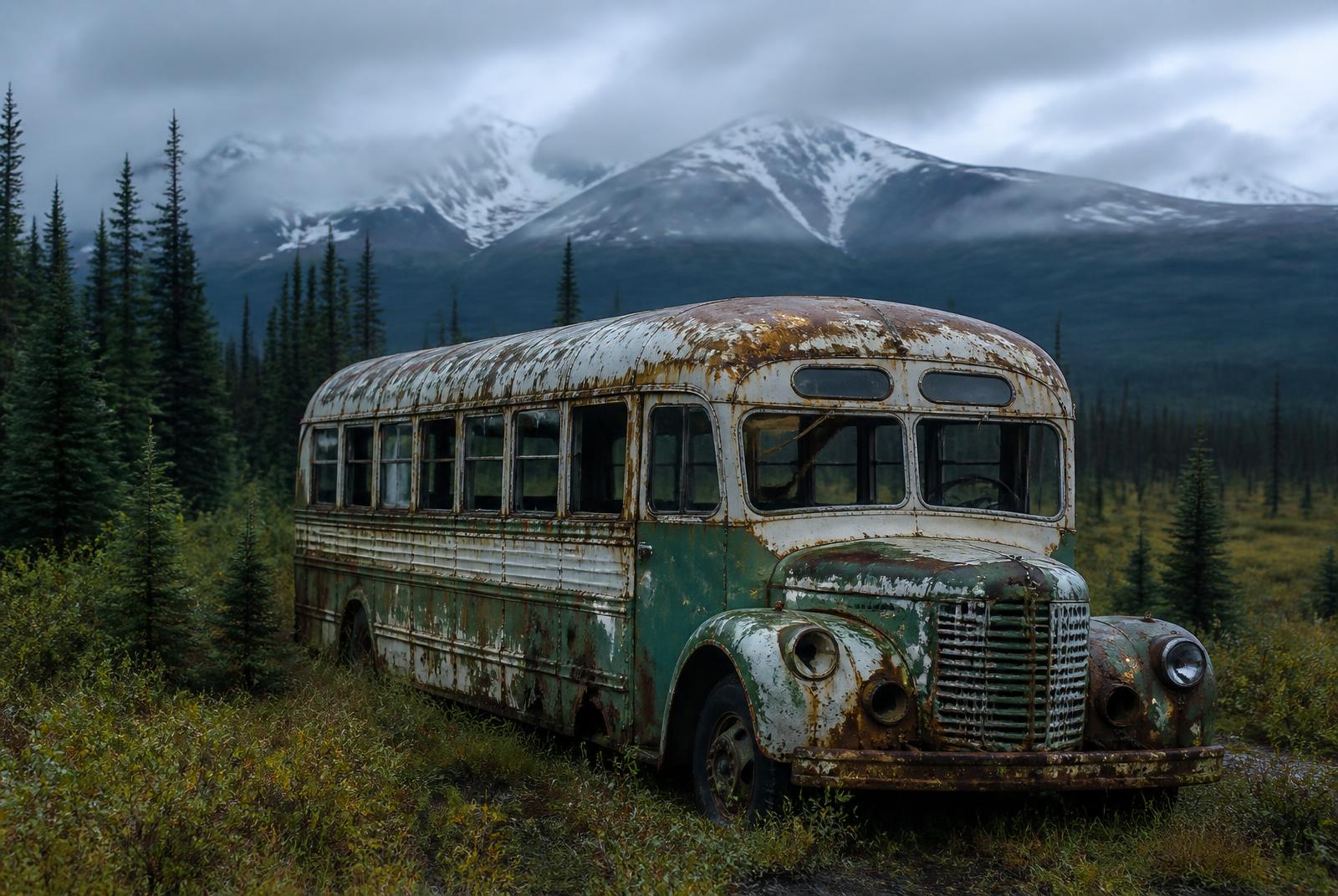
For 28 years, the famous 'Into the Wild' bus sat rusting in a spruce forest west of Healy. Then, a helicopter came and took it away. Come with us to explore the story of Bus 142, the travelers it drew, and where you can find it today.
First off, let's set the record straight about the so-called Magic Bus. It was never truly magical, and it wasn't really lost. Fairbanks Bus 142 started out as a regular 1946 International Harvester, just like any other, taking people around a small Alaskan city. After its retirement, its engine was removed, and it was towed up the Stampede Trail around 1961 to serve as a shelter for a road construction crew. However, that road was never finished.
The bus ended up with a broken axle and was left behind at Mile 49. It had a simple barrel stove and a bunk inside, and for three decades, it was simply a useful shelter for hunters caught in bad weather.
Then, in April 1992, a young man named Christopher McCandless walked along that very trail. He was 24 years old, had given away all his savings, and carried just a bag of rice and a small rifle. He ended up staying there for 113 days, reading, hunting, and writing notes in his books. In July, he tried to leave, only to discover that the Teklanika River – which was just a shallow stream when he crossed it in spring – had become a raging, gray flood of melting glacier water. He had to return to the bus. Moose hunters eventually found his body on September 6.
Jon Krakauer's book, "Into the Wild," published in 1996, brought the bus worldwide fame. Sean Penn's film adaptation in 2007 turned it into a real-life destination. What followed was a unique kind of tourism. People would fly to Anchorage, drive north, park their cars at the end of the road near Healy, and then hike twenty miles into swampy, bear-filled wilderness, often in flimsy sneakers. They were all chasing after a wreck they had only seen on a movie screen. Some visitors carved their names into the bus, while others left messages for a man who had been gone for twenty years. Year after year, Alaska State Troopers rescued stranded hikers from the far bank of the Teklanika. Tragically, a Swiss woman drowned trying to cross it in 2010, and a woman from Belarus met the same fate in 2019.
Long before Alaskans disagreed about the bus, they were divided about Christopher McCandless himself. One way to look at his story is that he was a young man who bravely tried to face the wilderness on its own terms and, sadly, lost. Another view suggests he was an unprepared tourist who, after his death, inspired others to make similar dangerous journeys. Even the cause of his death is still debated. Krakauer suggested that wild potato seeds he ate contained a toxin that would have weakened a starving body, but other researchers believe a poor hunting season and lack of food are enough to explain what happened. No one has truly settled this mystery, and that lingering uncertainty is a big reason why so many people felt compelled to make the pilgrimage.
On June 18, 2020, the state decided to end it. The Alaska Army National Guard flew a Chinook helicopter to Mile 49, secured the bus with slings, and lifted it into the sky. This was a training exercise, but it also served as a rescue mission for anyone else who might have tried to reach the bus. Today, the clearing is empty. All that remains at the end of the Stampede Trail is the spot where something used to be.
But the bus itself survived! The University of Alaska Museum of the North in Fairbanks welcomed it, and after a careful conservation program to stabilize the rust, bullet holes, and carved graffiti (without erasing its history), it is now on display. You can walk right up to it from a nearby car park in just a few minutes. That's the whole point: the very object that caused so much danger by being hard to reach is now safe and accessible. It is still, unmistakably, the same bus: dented green and white, windows missing, and the old stove still inside.
If you plan to visit Fairbanks to see it, try to go in summer for the endless daylight, or in winter for the chance to see the aurora borealis. Afterwards, drive two hours south to Healy, where you'll find a replica of the bus outside a brewery. But make sure to spend some time in front of the real one first. You'll likely find it's smaller than you expected, and much more ordinary. And in a way, that's the most honest part of its story.
Plan the trip
Book this journey
We may earn a commission from these partner links, at no extra cost to you.
Visit the place
Practical details, mystery rating and how to plan the trip.