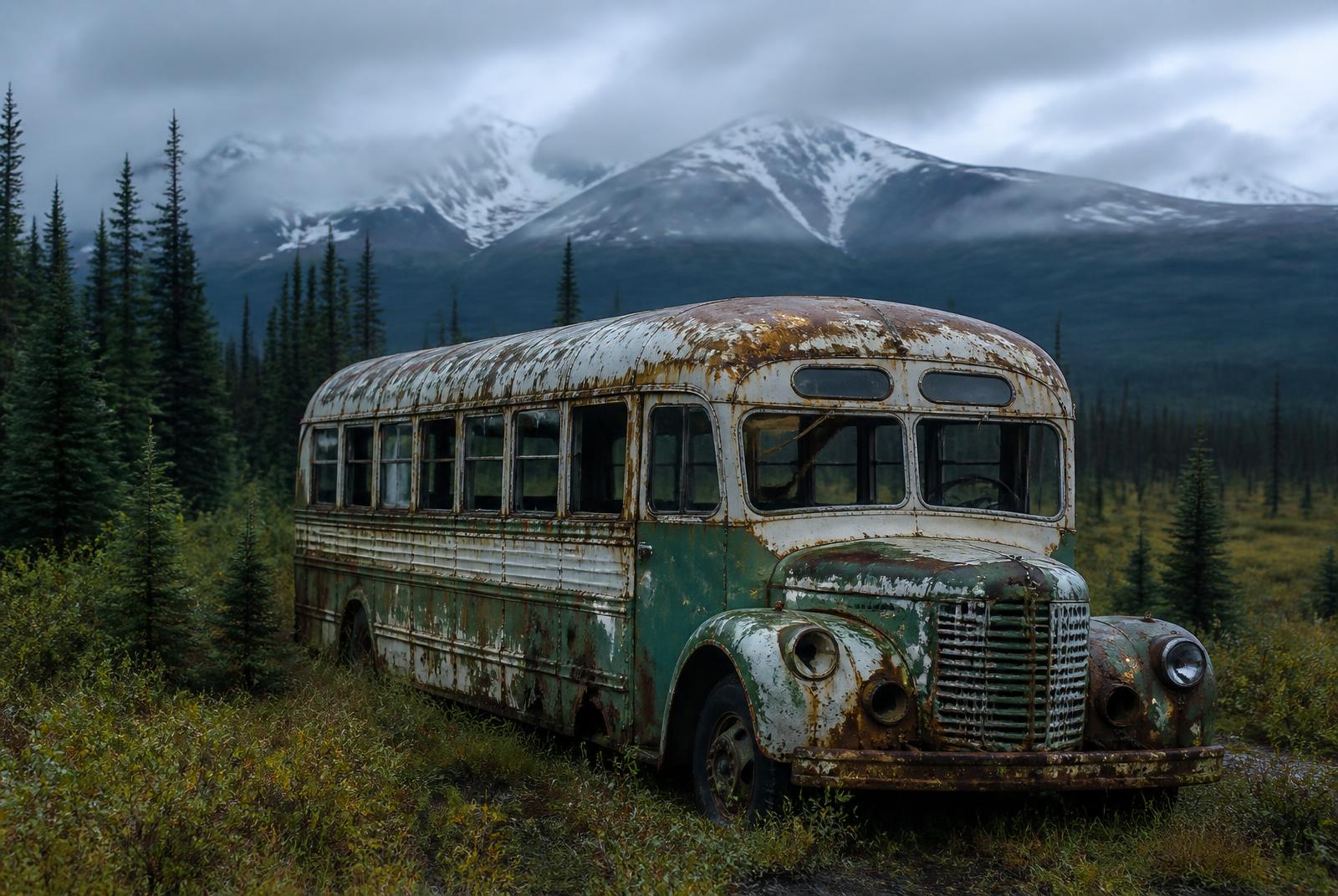
Bus 142 — The Into the Wild Magic Bus
Fairbanks, Alaska, USA1946–present
Mystery rating
Bus 142 is the abandoned bus where Christopher McCandless died in Alaska in 1992, made famous by the book and film Into the Wild. So many people got into trouble trying to reach it that the bus was airlifted out in 2020. It is now on display in Fairbanks, and the original site is empty.
Why GeisTrack picked it
This is one of the few literary landmarks that existed as an actual object in real wilderness before becoming a museum piece. The move from remote hazard to protected exhibit, driven directly by fatalities on the pilgrimage route, makes it a rare case where a story's popularity physically reshaped the site itself.
Why it's famous
Bus 142 is famous as the real setting of Jon Krakauer's "Into the Wild" and Sean Penn's 2007 film. Originally a Fairbanks city transit bus, it was towed up the Stampede Trail around 1961 to shelter road workers on an unfinished mining route, then left behind at Mile 49 with a broken axle. For thirty years it served as an emergency shelter for hunters and trappers. In April 1992, 24-year-old Christopher McCandless walked in with a rifle and a bag of rice and lived there for 113 days before dying of starvation. His story turned an obscure wreck into a pilgrimage site, drawing hikers across a dangerous, glacier-fed river that killed at least two people trying to reach it. In 2020, officials airlifted the bus out by helicopter to end the risky treks. It's now preserved and displayed at the University of Alaska Museum of the North.
History
Bus 142 actually started its life as a regular city transit bus in Fairbanks. Around 1960–61, the Yutan Construction Company hauled several old, retired buses up the Stampede Trail. They planned for these buses to house workers who were building a mining road toward the Kantishna area. But the project was stopped because the state ran out of money, and new rules closed the route. The crews managed to bring most of the buses back, but Bus 142 had a broken axle. It was left behind at Mile 49, meant to be an emergency shelter. It even came with a barrel stove and a bunk bed. For thirty years, it served that exact purpose. After 1992, however, it became much more. Visitors started carving their names into its panels and leaving notes and food supplies. By the 2010s, Alaska State Troopers were often receiving calls from hikers who were stuck on the wrong side of the Teklanika River. Tragically, two women drowned while trying to cross the river in 2010 and 2019. Because of these dangers, the Alaska Department of Natural Resources had the bus removed by air on June 18, 2020. After a two-year preservation effort, it went on public display at the Museum of the North, located on the University of Alaska Fairbanks campus.
The full story
For nearly a generation, Bus 142 from Fairbanks sat in a clearing surrounded by black spruce trees, just west of Healy, Alaska, near the edge of Denali National Park. This old bus was a 1946 International Harvester. Its engine had been removed, and it was towed up the Stampede Trail in the early 1960s to serve as a shelter for a road crew. But that road was never finished. When the construction stopped, the bus stayed right where it was. Hunters, trappers, and people riding snowmobiles all used it as a shelter. Someone even installed a wood-burning stove inside. Then, in April 1992, a 24-year-old man from Virginia named Christopher McCandless walked along that very trail. He carried a ten-pound bag of rice and a .22 rifle, and he made the bus his home. He lived there for 113 days. During that time, he hunted small animals and even a moose, though he couldn't properly preserve the meat. He spent his days reading books by authors like Tolstoy and Thoreau, filling the margins with his own thoughts. In July, he tried to leave, but he found the Teklanika River, which had been just a shallow stream in April, now swollen with melting glacier water and impossible to cross. So, he returned to the bus. Moose hunters discovered his body on September 6, 1992; he weighed only about 30 kilograms (around 66 pounds). Jon Krakauer's 1996 book, "Into the Wild," and Sean Penn's 2007 film based on it, turned this isolated wreck into a famous pilgrimage site. Many people tried to reach it, trekking through swamps, dangerous bear country, and across a river that has unfortunately claimed at least two lives. In June 2020, the Alaska Army National Guard used a Chinook helicopter to lift the bus from the tundra. This rescue operation put an end to nearly 30 years of risky treks and emergency calls. So, if you're wondering if the bus still exists, the answer is yes — but not in the wild anymore. The University of Alaska Museum of the North in Fairbanks has carefully preserved it, and it's now an exhibit. You can see it, still dented, rusted, and clearly the same vehicle that captured the world's imagination.
Legends & sightings
Alaskans have been discussing and debating Bus 142 for thirty years, and these conversations have become part of its story. Some believe Christopher McCandless was a young man who bravely went into the wilderness and faced nature head-on. Others see him as someone who was unprepared, and they view the bus as a reminder of a death that could have been prevented, a death that has unfortunately led to others. There's still disagreement about how he starved: Jon Krakauer suggested that wild potato seeds containing a toxic amino acid called ODAP might have played a role, while other researchers think a simple lack of calories explains it. No single theory has been fully accepted, which is one reason why people kept trying to reach the bus.
Fact or legend?
Documented: McCandless died at the bus in August 1992. In June 2020 the Alaska Army National Guard lifted the bus out by helicopter because of repeated rescues and two deaths of people trying to reach it. The bus is now conserved by the Museum of the North at the University of Alaska Fairbanks. Debated: the exact cause of his death is still argued over, with theories about starvation and about toxic seeds. No single answer is agreed. Important: the bus is no longer in the wild. Anyone telling you otherwise is out of date.
Field notes
- The bus is a 1946 International Harvester K-5, a Fairbanks city transit vehicle before it was towed up the Stampede Trail around 1961.
- It was left at Mile 49 because of a broken axle, and stocked as an emergency shelter with a barrel stove and bunks.
- McCandless lived in it for 113 days in 1992 and was found on 6 September by moose hunters.
- At least two hikers drowned in the Teklanika River attempting the pilgrimage, in 2010 and 2019.
- The Alaska Army National Guard airlifted the bus out by Chinook helicopter on 18 June 2020 as a training mission.
- After conservation it went on display outdoors at the University of Alaska Museum of the North in Fairbanks.
- Sean Penn's 2007 film used a replica bus, not the original — that replica sits at a brewery in Healy.
Our verdict
GeisTrack Verdict
The bus is genuinely worth seeing, but not in the way its early pilgrims expected. Reaching the original site meant crossing a river that killed people, and that danger was never really the point of McCandless's story. Now that the bus sits safely in a Fairbanks museum, visitors get the same rusted, dented vehicle without the risk. Fans of the book or film will find it moving to stand next to the real thing. Anyone hoping for a wilderness pilgrimage will be disappointed, since the museum experience is closer to viewing a preserved artifact than an adventure. Pair it with Denali or Chena Hot Springs to make the trip worthwhile beyond the bus itself.
Editorial assessment based on research, not a sponsored review. See our editorial policy.
Can you visit?
Yes, in Fairbanks. The bus is cared for by the Museum of the North and displayed as part of its work, so check the museum's current information before travelling. The old site on the Stampede Trail has nothing to see and the river crossing that killed people is still dangerous. Do not go there.
How to get there
Fairbanks is the destination now. 1. Fly into Fairbanks International (FAI), or drive or take the train from Anchorage. 2. The Museum of the North is on the University of Alaska Fairbanks campus, a short drive from the city centre. 3. Local buses and taxis serve the campus, and there is parking on site.
Before you go
Check the museum's opening hours and current display information before you go, as exhibits change. Summer has long daylight and the easiest travel. Winter in Fairbanks is extremely cold. If you are visiting Alaska for hiking, take local advice seriously. River levels change fast. Do not attempt the Stampede Trail crossing.
Travel tips
To visit, fly into Fairbanks International Airport, rent a car, and combine your museum visit with a trip to Chena Hot Springs Road and a night spent watching for the aurora. Healy, about two hours south of Fairbanks, has a replica of the bus used in the film and is also a gateway to Denali National Park.
Safety
Please do not try to hike the Stampede Trail to reach the bus's original location. The bus is no longer there, and the Teklanika River crossing has been deadly for hikers. Instead, the bus is now safely displayed in a museum, easily accessible for a visit.
What to expect
A museum visit rather than a wilderness trip. You see the bus itself, with its history explained honestly, alongside the museum's Alaskan collections. It takes a couple of hours. Fairbanks also gives you northern lights in winter and a good base for wider Alaska travel.
Visit with respect
A young man died here and two more people died trying to reach the site. Treat the bus as a memorial, not a photo prop.
Frequently asked
Plan your trip
Book the practical parts of the journey. We may earn a commission from these partner links, at no extra cost to you.
Plan your visit
Getting to Bus 142 — The Into the Wild Magic Bus
Everything you need to turn this mystery into a trip. We may earn a commission from these partner links, at no extra cost to you.
- Best time to visit
- Visit between June and August to enjoy the midnight sun, or from September to March if you want to experience the aurora borealis over Fairbanks.
- Opening hours
- Museum of the North: typically 9am–7pm in summer and 10am–5pm in winter; confirm before you travel.
- Entrance fee
- Museum admission applies; roughly $20 for adults.
Continue your GeisTrack
Other places on GeisTrack that pair well with Bus 142 — The Into the Wild Magic Bus — same kind of story, or the same corner of the map.
Japan
Hashima Island
Hashima, known as Battleship Island, is a small concrete island off Nagasaki. Thousands of coal miners and their families lived here in some of Japan's first big concrete apartment blocks. The mine closed in 1974 and everyone left within weeks. The buildings have been falling apart ever since.
Namibia
Kolmanskop
Kolmanskop is a German built diamond town in the Namib desert, near Lüderitz in Namibia. It was rich, then the diamonds ran out, and by 1956 it was empty. Sand has poured through the doors ever since. Some rooms are half full of dunes.
USA
Alcatraz Island
Alcatraz is a small rocky island in San Francisco Bay. For 29 years it held some of the most famous prisoners in the United States. The prison closed in 1963 and is now a museum. People come for the history, the view back at the city, and the story of the three men who escaped and were never found.
Or browse every abandoned places entry, or open the interactive atlas.
Read the story
Long-form journal writing about Bus 142 — The Into the Wild Magic Bus.
Rate This Destination
What do you think of this destination? Share your rating with the GeisTrack community.
Community Rating
No ratings yet. Be the first to rate this destination.
Visitor opinion only — separate from the GeisTrack editorial mystery ratings above.
Been here? Share your experience
Have you visited this place? Tell other GeisTrack travelers what it was really like. Your experience may help someone plan their own visit.
No comments yet
No traveler comments yet. Be the first to share your thoughts.