Kolmanskop
Lüderitz, Karas, Namibia20th century
Mystery rating
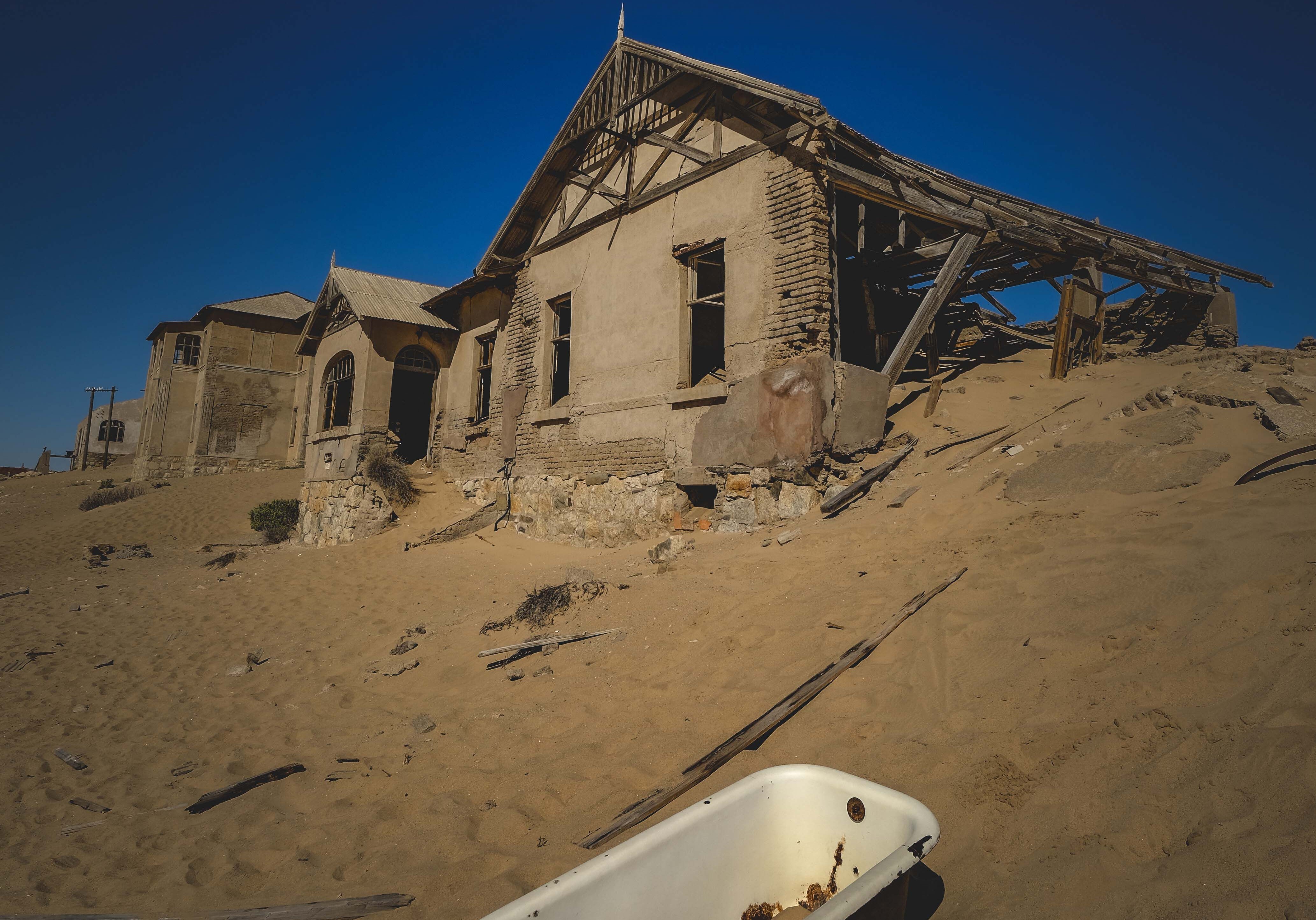
Kolmanskop is a German built diamond town in the Namib desert, near Lüderitz in Namibia. It was rich, then the diamonds ran out, and by 1956 it was empty. Sand has poured through the doors ever since. Some rooms are half full of dunes.
Why GeisTrack picked it
Kolmanskop makes the list because its abandonment is entirely natural rather than staged for tourists. The sand didn't arrive after the fact for photographs; it has been accumulating steadily for nearly 70 years, and the restricted zone that once enforced diamond security is the same reason the interiors survived untouched.
Why it's famous
Zacharias Lewala's 1908 discovery near Lüderitz triggered a diamond rush so intense that men crawled the gravel plains by moonlight picking up stones by hand. The resulting town, built in German colonial style with grand homes, a hospital, a theatre, and an ice factory that delivered a free block to every household daily, produced 11.7 percent of the world's diamonds in 1912 alone. Around 300 German colonists and 800 Owambo contract workers lived there, though conditions for the two groups were nowhere close to equal. Richer diamond fields discovered at Oranjemund in 1928 drained the town through the 1930s, and the last family left in 1956. Because Kolmanskop sits inside a restricted diamond zone, no one could loot it afterward. The Namib Desert simply moved in on its own, filling rooms with sand that now reaches halfway up the walls and pours through open doors in sharp beams of morning light.
History
Back in 1908, a railway worker named Zacharias Lewala was clearing sand from the tracks near Lüderitz. He picked up a stone and showed it to his supervisor, August Stauch. It turned out to be a diamond. Within just a few weeks, the German colonial government in what was then German South West Africa declared a 'Sperrgebiet' (a forbidden zone). This kicked off a diamond rush where men would crawl across the gravel plains under the full moon, picking up stones by hand. The company town that grew from this discovery was remarkably German in its style and amenities. It featured grand homes with sloped roofs, a hospital, a school, a theatre and concert hall, a casino, a skittle alley, and an ice factory that delivered a free block of ice to every household daily. Fresh water was even shipped over 1,000 kilometers from Cape Town. Around 300 German adults, 40 children, and 800 Owambo contract workers lived here. It's important to remember that the living conditions for the contract laborers were much harder than the comfortable lives enjoyed by the colonists. However, geological luck eventually shifted. By 1928, richer and easier-to-access diamond fields were discovered at Oranjemund, further south along the Orange River. Kolmanskop began to empty out during the 1930s. The very last family moved away in 1956. Since the town is located within a restricted diamond area, no one was able to loot or vandalize it. Instead, the Namib Desert simply took over.
The full story
Kolmanskop is located just 10 kilometers inland from Lüderitz, right off the B4 highway. Before you head out, you'll need to grab a permit – you can buy one in Lüderitz or online. Standard tickets usually include a guided tour at 9:30 AM or 11:00 AM. But if you want the best experience, get the photographer's permit. This special pass lets you enter at sunrise, long before the crowds arrive. Seriously, do it. As the sun first comes up, the interiors of the buildings are incredible. The morning light streams through empty window frames, illuminating the dust in the air. The sand dunes inside the rooms glow orange, contrasting beautifully with the peeling turquoise, ochre, and rose-colored plaster. Just a couple of hours later, that magic light disappears, and the rooms look much less dramatic. Start your exploration with the sand-filled houses on the eastern side. Here, the sand drifts are chest-high, and doorways perfectly frame the vast dunes outside. Then, make your way back to the town's public buildings. You'll find the ballroom and theatre, with its stage still surprisingly intact, plus a skittle alley (that's like a bowling lane), a shop, an ice factory, and even a hospital. This hospital was quite advanced for its time, housing the first X-ray machine south of the equator – partly used to check workers for diamonds they might have swallowed. A small museum on site will tell you more about the exciting diamond rush. Even with the photographer's permit, definitely take the guided tour. The local guides are entertaining, witty, and share fascinating details you'd never discover on your own. They'll tell you about the free block of ice delivered daily to every home, the lemonade factory, and the water carts pulled by camels. After your visit, consider exploring Lüderitz itself. It's a unique port town on the Atlantic coast, featuring strange Bavarian-style and Art Nouveau buildings. Check out places like the Goerke Haus and Felsenkirche (a charming church on a rocky hill), and enjoy fresh oysters and cold Namibian beer. You can also drive to Diaz Point to see seals and flamingos, or head south to Aus to spot the famous desert horses. Remember to bring something to protect your camera from dust, plenty of water, and a windproof jacket. The coastal wind is constant and strong, making it colder here than in most other parts of Namibia.
Legends & sightings
People who work at Kolmanskop will tell you that the town isn't truly empty. Guides often share stories of hearing footsteps on the wooden floors of the manager's house, a piano playing in the concert hall, and even seeing a child at an upstairs window in the accountant's residence. They say the child always appears in the same window, just before the tour groups start arriving. There's a persistent story about the ballroom, too: on nights when the wind blows steadily from the south, the room hums softly, almost as if it remembers an orchestra playing. Some might explain this by saying the wind moving across the empty window frames creates a sound, much like blowing across the top of a bottle. But it seems no one who works there has ever been fully convinced by that simple explanation. The oldest legend, however, belongs to the desert itself. The Nama people, who are local to the area, call this coastline 'the Sand That Cries.' Both they and later Portuguese sailors saw this shore – the southern edge of the infamous Skeleton Coast, littered with shipwrecks and whale bones – as a place that swallows people. Kolmanskop, named after a transport driver whose ox wagon got stuck here and who tragically died in the dunes, perhaps seemed destined for its fate right from the start.
Fact or legend?
Documented: diamonds were found here in 1908 and the town grew fast, with a hospital, a theatre and the first X-ray machine in southern Africa. Better diamond fields further south drew people away and the town was abandoned by the mid 1950s. Not a ghost story: Kolmanskop is famous for decay and photography, not for hauntings. Restricted land: it sits inside a diamond mining area, which is why access is controlled.
Field notes
- The town was founded after a railway worker picked a diamond off the sand in 1908.
- In 1912 Kolmanskop's fields produced roughly 11.7% of the world's diamonds.
- It had a ballroom, theatre, casino, skittle alley and the first X-ray machine in the southern hemisphere.
- Every household received a free block of ice delivered daily; freshwater came by ship from Cape Town.
- The last inhabitants left in 1956 and the Namib has been filling the buildings ever since.
- Because the town sits inside a restricted diamond zone, it was never looted — which is why the interiors survive.
Our verdict
GeisTrack Verdict
This is one of the more reliably rewarding stops in the abandoned-places category, especially for photographers. Buy the sunrise permit if you can; the difference in light between early morning and midday is dramatic, and the standard 9:30 or 11:00 tours miss the best conditions entirely. The ghost stories about footsteps and a piano playing in the ballroom are pure atmosphere with no documented basis, but you don't need them: the real history of the diamond rush, the free daily ice, and the X-ray machine used to check workers for swallowed stones is compelling on its own. Expect wind, sand in your camera gear, and a site that rewards an early start far more than a lazy one.
Editorial assessment based on research, not a sponsored review. See our editorial policy.
Can you visit?
Yes, with a permit. Kolmanskop lies inside the restricted Sperrgebiet diamond zone, so you buy a permit or a tour ticket, usually in Lüderitz or at the gate. Standard tickets cover normal daytime hours with a guided tour. Separate, more expensive photographer permits allow sunrise and sunset access. Do not wander outside the marked town area.
How to get there
1. Fly into Windhoek (WDH), then fly or drive to Lüderitz. The drive is long, several hundred kilometres across the desert. 2. From Lüderitz, Kolmanskop is about 10 km east on the B4, roughly 15 minutes by car. 3. There is no public transport, so drive or join a tour from Lüderitz. Fuel up in Lüderitz and check your route before crossing the desert.
Before you go
Buy your permit in advance in Lüderitz if you want early or late light. Mornings are calmer. Wind and blowing sand pick up later in the day. Bring water, sun protection and something to cover your camera. Sand gets everywhere. Floors are unstable in places, so watch your step and do not climb on damaged structures. Nights on the coast are cold, and sea fog is common.
Travel tips
To get those incredible images Kolmanskop is famous for, make sure to buy the photographer's permit and arrive at sunrise. It truly makes all the difference compared to just taking snapshots. Afterward, join the guided tour to hear all the fascinating stories. Don't forget to protect your camera from the fine sand, carry plenty of water, and pack a windproof jacket; the Atlantic coast here is cold and quite windy.
Safety
You are within a restricted diamond zone, so always keep your permit with you and only stay in the marked areas.
What to expect
A short guided tour explains the town, then you can walk freely in the permitted area. You step through doorways into rooms filled with sand up to the windows, peeling paint and desert light. It is a photographer's site above all. Two to three hours is normal.
Visit with respect
The buildings are fragile. Do not remove objects, carve names or force doors, and follow the guide's warnings about unsafe floors.
Frequently asked
Plan your trip
Book the practical parts of the journey. We may earn a commission from these partner links, at no extra cost to you.
Plan your visit
Getting to Kolmanskop
Everything you need to turn this mystery into a trip. We may earn a commission from these partner links, at no extra cost to you.
- Best time to visit
- April to October, ideally at sunrise
- Opening hours
- Tours at 09:30 and 11:00; photo permits from sunrise
- Entrance fee
- Approx. NAD 130, more for photo permits
Continue your GeisTrack
Other places on GeisTrack that pair well with Kolmanskop — same kind of story, or the same corner of the map.
Make it a route
Combine Kolmanskop with Lüderitz, the wild horses at Aus and the Fish River Canyon on a southern Namibia route.
Japan
Hashima Island
Hashima, known as Battleship Island, is a small concrete island off Nagasaki. Thousands of coal miners and their families lived here in some of Japan's first big concrete apartment blocks. The mine closed in 1974 and everyone left within weeks. The buildings have been falling apart ever since.
USA
Bus 142 — The Into the Wild Magic Bus
Bus 142 is the abandoned bus where Christopher McCandless died in Alaska in 1992, made famous by the book and film Into the Wild. So many people got into trouble trying to reach it that the bus was airlifted out in 2020. It is now on display in Fairbanks, and the original site is empty.
Or browse every abandoned places entry, or open the interactive atlas.
Read the story
Long-form journal writing about Kolmanskop.
Rate This Destination
What do you think of this destination? Share your rating with the GeisTrack community.
Community Rating
No ratings yet. Be the first to rate this destination.
Visitor opinion only — separate from the GeisTrack editorial mystery ratings above.
Been here? Share your experience
Have you visited this place? Tell other GeisTrack travelers what it was really like. Your experience may help someone plan their own visit.
No comments yet
No traveler comments yet. Be the first to share your thoughts.