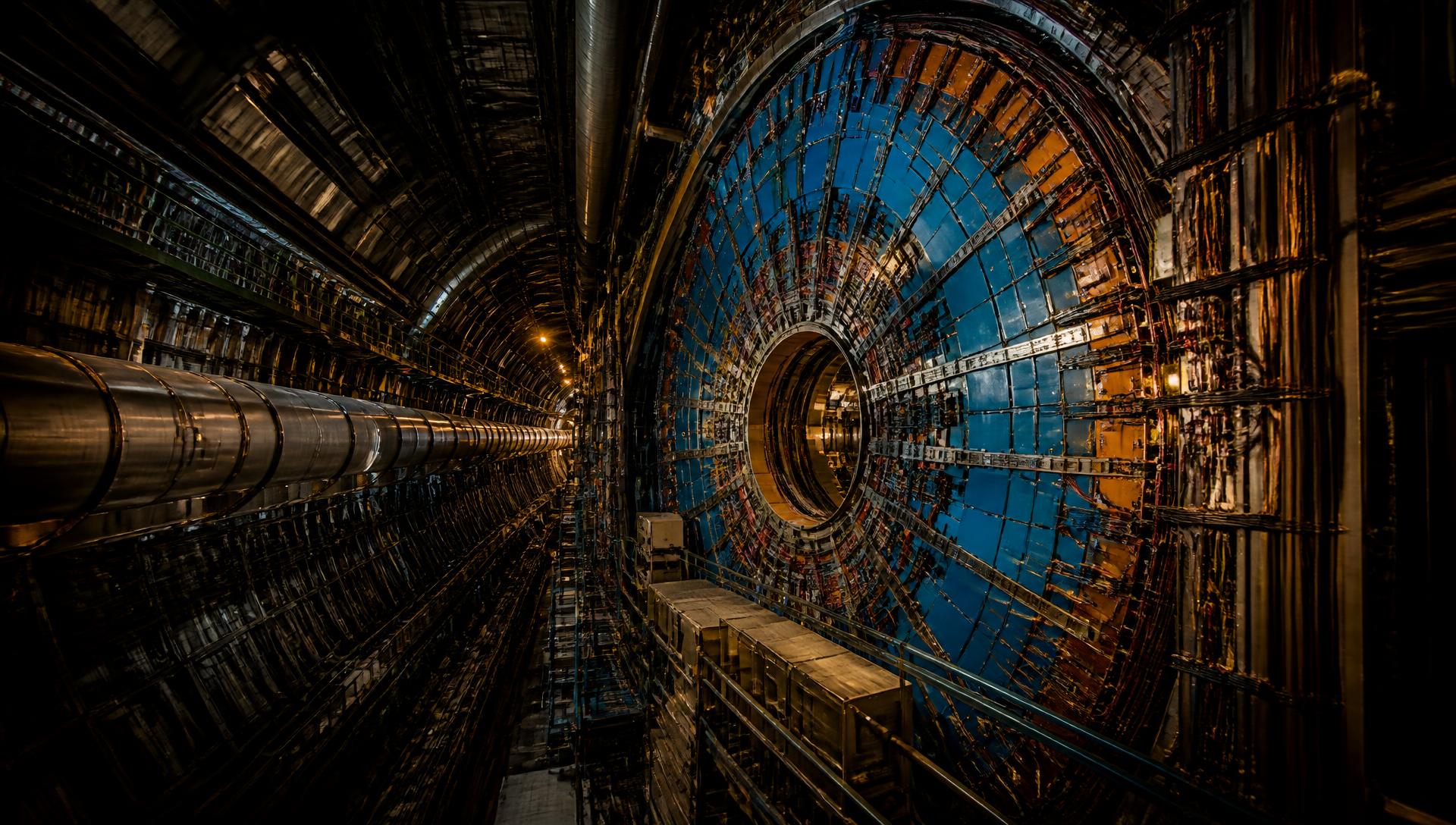
CERN & the Large Hadron Collider
Meyrin, Canton of Geneva, SwitzerlandModern era (1954–present)
Mystery rating
CERN sits on the border between Switzerland and France, near Geneva. Under the fields runs a 27 km circular tunnel where scientists smash particles together to find out what the universe is made of. The Higgs boson was confirmed here in 2012.
Why GeisTrack picked it
GeisTrack usually covers places built on mystery and speculation, but CERN belongs here because it attracts exactly that kind of curiosity, minus the guesswork. Conspiracy theories about dimensional doorways and time shifts circulate constantly, fuelled partly by a bronze Shiva statue outside Building 40. The actual science on offer is stranger and better documented than any of the myths built around it.
Why it's famous
CERN's reputation rests on real breakthroughs rather than speculation. It is where Tim Berners-Lee wrote the 1989 proposal that became the World Wide Web, where physicists routinely create and study antimatter, and where the Higgs boson was confirmed in 2012 after decades of searching. Few research sites anywhere combine that many landmark discoveries in one location. The Large Hadron Collider itself, switched on in 2008, sits 100 metres underground and cools its magnets to −271.3°C, colder than deep space. CERN was founded in 1954 by twelve European countries as a peacetime scientific collaboration, meant to rebuild cross-border science after the war. That founding idea — cooperation over competition — still shapes how the site operates and how openly it shares its work with visitors.
History
CERN started in 1954, founded by twelve European countries as a project for peace. The idea was for former enemies to work together to rebuild science. What began as a small particle accelerator grew into the largest machine humanity has ever built. The Large Hadron Collider (LHC) was switched on in 2008. It sits 100 meters (about 328 feet) underground, beneath vineyards, villages, and the Jura mountains. Its magnets need to be cooled to an incredibly cold -271.3 °C (-456.3 °F), which is even colder than deep space. And don't forget, in 1989, a physicist working at CERN named Tim Berners-Lee wrote a proposal that his boss famously called "vague but exciting." That proposal became the World Wide Web.
The full story
When you arrive, you might expect a heavily guarded fortress, but instead, you'll discover a lively campus. You'll see bicycles leaning against temporary buildings, and Nobel Prize winners chatting over coffee in the canteen. The hallways are filled with hand-drawn diagrams that span decades of brilliant work. The true scale of this place only becomes clear when you head underground. Imagine standing in front of an experiment cavern as big as a grand cathedral, crisscrossed with orange cables and shiny steel structures. That's when you realize this scientific instrument is designed to match human ambition, not just human size. The best way to experience CERN is by taking a guided tour, which is completely free. Depending on the day and the schedule of the machines, you might even get to go down into an experiment area. Sometimes, when the particle beams are running, those caverns are sealed off for safety. But no matter what, you can always visit the Science Gateway. This visitor complex, designed by famous architect Renzo Piano and opened in 2023, displays actual parts from the Large Hadron Collider's past like precious artifacts. You'll see a section of the beam pipe, a retired detector wheel, and even the NeXT cube computer where the World Wide Web first began. The peaceful countryside around CERN is also part of the charm. Even though you can't see it, the giant ring of the collider runs underneath farms, the flight path for Geneva Airport, and the small French village of Cessy. If you walk or cycle along part of its path, you'll get a unique thrill knowing that particles are zipping around 11,000 times every second right under your feet. In the evening, Geneva's beautiful lakefront is just a fifteen-minute tram ride away. This city, famous for its watchmakers and diplomats, has quietly hosted the most extraordinary machine on Earth for seventy years. For travelers who love visiting places where human history took a big turn, CERN truly belongs on that special list, right alongside places like Kitty Hawk (where the Wright brothers first flew) and Los Alamos (where the atomic bomb was developed). It’s not spooky or eerie. Instead, it offers something even more unique: a mystery that is real, still unfolding, and being measured with incredible precision by brilliant scientists who are happy to share their discoveries with you over a casual lunch.
Legends & sightings
CERN seems to attract more conspiracy theories than any other laboratory in the world. Some people believe the collider can open doors to other dimensions, cause time to shift, or explain things like the "Mandela Effect" (where many people remember something differently than it actually happened). Outside Building 40, you'll see a bronze statue of Shiva Nataraja, a Hindu deity shown dancing in a circle of flames. India gifted this statue to CERN in 2004, and for two decades, some have pointed to it as proof that something mystical or occult is happening deep underground. The staff at CERN, with a good sense of humor, even sell postcards of it in their gift shop.
Fact or legend?
Documented: CERN is a real research organisation founded in 1954. The Large Hadron Collider is the largest machine ever built, and the World Wide Web was invented here by Tim Berners-Lee in 1989. Claims online: stories about CERN opening portals or causing disasters are internet rumour. Physicists checked the safety questions before the machine started, and the collisions are far weaker than events that happen naturally in the atmosphere. Honest position: the mystery here is real science, not the conspiracy version of it.
Field notes
- The LHC magnets are cooled to −271.3 °C — colder than outer space.
- Protons in the beam travel at 99.9999991% of the speed of light, circling the 27 km ring 11,245 times per second.
- The World Wide Web was invented at CERN in 1989 and released royalty-free in 1993.
- CERN routinely produces antimatter — but the total ever made would not power a light bulb for more than a few minutes.
- The Shiva statue outside Building 40 was a 2004 gift from the Government of India, not an occult installation.
Our verdict
GeisTrack Verdict
CERN is worth the trip for anyone curious about how real scientific discovery happens, and the free guided tours and Science Gateway exhibits make it accessible even without a physics background. It isn't spooky, and travellers hoping for something eerie will be disappointed — the vibe is closer to a university campus than a supernatural site. What makes it interesting is the contrast between the vast scale of the underground machinery and the casual, open atmosphere above ground, where Nobel laureates chat over lunch. Book tour tickets early; they sell out within hours. Best for science-minded travellers passing through Geneva, less so for those chasing an atmosphere of dread.
Editorial assessment based on research, not a sponsored review. See our editorial policy.
Can you visit?
Yes, partly. CERN has a free public visitor centre, Science Gateway, with exhibitions open to everyone. Guided tours of the underground areas are limited, must be booked far ahead, and are not available while the machine is running. You cannot walk into the tunnels on your own.
How to get there
Geneva is the gateway. 1. Fly into Geneva (GVA). 2. Take the tram from the city centre to its end stop at CERN. Geneva public transport is straightforward and hotels often give free travel passes. 3. The visitor buildings are next to the tram stop. Driving is possible and there is parking, but the tram is easier.
Before you go
Book any guided tour as far ahead as you can. Free places disappear quickly. Bring photo ID for tours. Allow half a day for the exhibitions. The site is spread over a large area, so wear comfortable shoes. Underground visits are not always possible, so do not build your whole trip around one.
Travel tips
Make sure to book your tour tickets the moment they become available online – they often disappear within hours. To get there, take tram 18 from Geneva right to the CERN stop. Your visitor pass also includes free public transport within Geneva. Plan for at least half a day for your visit, and for a complete experience, consider eating at Restaurant 1 on campus.
Safety
Remember, this is a working scientific site. You'll need photo ID, closed-toe shoes are a must, and whether you can access the underground experiment caverns depends on the current status of the particle beam. Rest assured, nothing on the public visitor route is radioactive.
What to expect
Science Gateway has hands on exhibits, real hardware and short shows aimed at anyone, not just physicists. You can see a section of an accelerator and displays explaining what the collisions actually do. Families do well here. If you get an underground tour, it is guided, timed and unforgettable.
Frequently asked
Plan your trip
Book the practical parts of the journey. We may earn a commission from these partner links, at no extra cost to you.
Plan your visit
Getting to CERN & the Large Hadron Collider
Everything you need to turn this mystery into a trip. We may earn a commission from these partner links, at no extra cost to you.
- Best time to visit
- Spring and autumn are the best times to visit. If you want the best chance to see the underground areas, try to visit during a technical stop, which usually happens in the winter.
- Opening hours
- Science Gateway: Tue–Sun, typically 09:00–17:00. Guided tours run several times daily and book out weeks ahead.
- Entrance fee
- Free — including guided tours and Science Gateway exhibitions. Booking required.
Continue your GeisTrack
Other places on GeisTrack that pair well with CERN & the Large Hadron Collider — same kind of story, or the same corner of the map.
Make it a route
Combine CERN with Geneva, the lake, and a day trip into the French Alps.
Or browse every science frontiers entry, or open the interactive atlas.
Read the story
Long-form journal writing about CERN & the Large Hadron Collider.
Rate This Destination
What do you think of this destination? Share your rating with the GeisTrack community.
Community Rating
No ratings yet. Be the first to rate this destination.
Visitor opinion only — separate from the GeisTrack editorial mystery ratings above.
Been here? Share your experience
Have you visited this place? Tell other GeisTrack travelers what it was really like. Your experience may help someone plan their own visit.
No comments yet
No traveler comments yet. Be the first to share your thoughts.