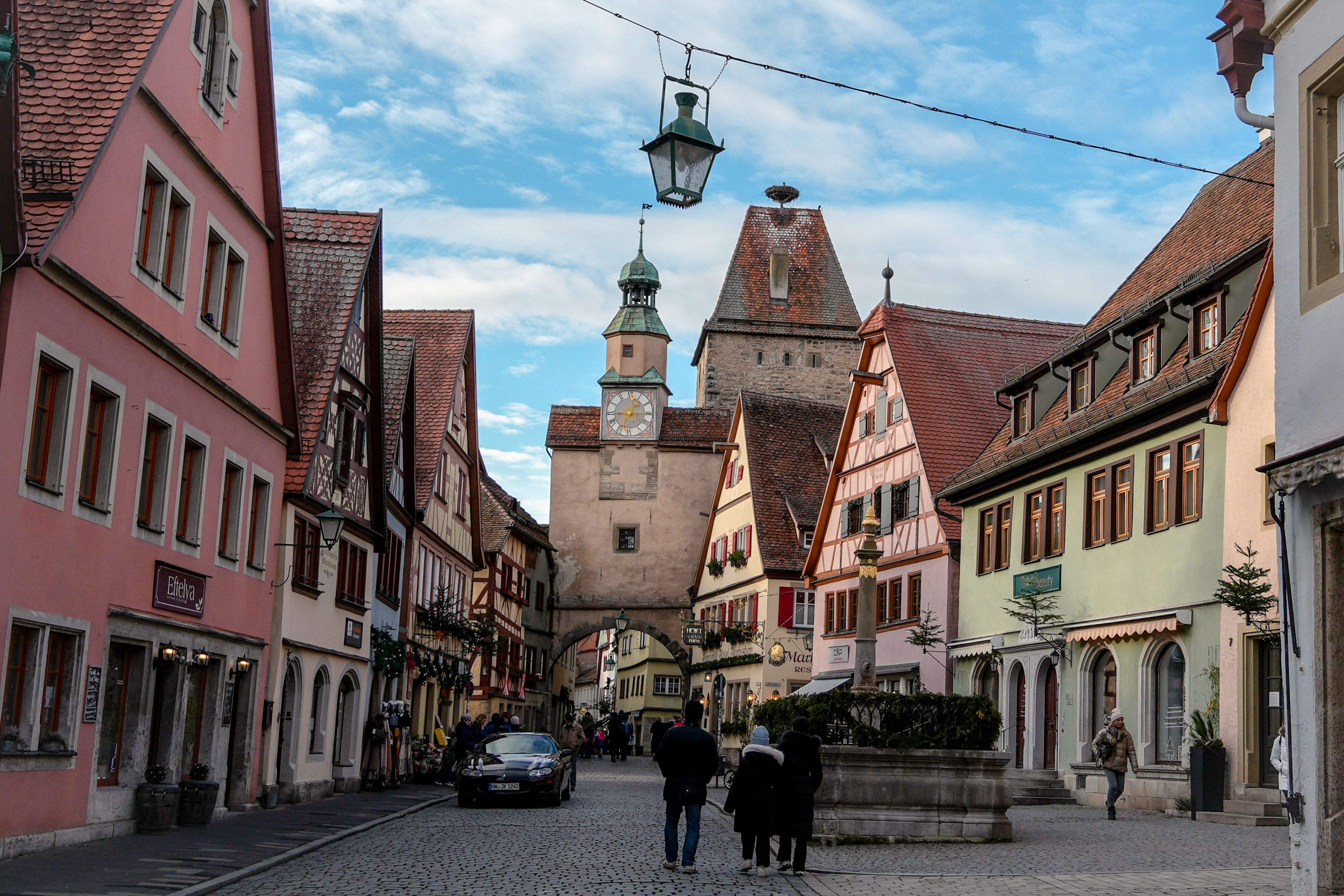
Rothenburg ob der Tauber
Rothenburg, Bavaria, Germany13th century
Mystery rating
Rothenburg ob der Tauber is a walled town in Bavaria that still looks medieval, with a complete ring of walls you can walk on. It stopped growing after war and plague in the 1600s, and poverty kept it frozen. Part of it was bombed in 1945 and carefully rebuilt.
Why GeisTrack picked it
Rothenburg belongs on GeisTrack because its preserved state is a direct result of historical hardship, not a themed reconstruction. The town's Meistertrunk legend, night watchman tours covering plague and execution history, and a Medieval Crime and Justice Museum give it a layer of grim local storytelling that goes beyond its postcard reputation.
Why it's famous
Rothenburg is Germany's best-preserved medieval town, and the reason is economic rather than deliberate preservation. After the Thirty Years' War and a subsequent plague, the town became too poor to tear down and rebuild, so its walls, towers and timber-framed houses simply stayed standing while wealthier cities modernised around them. Records show the town reached its peak under Mayor Heinrich Toppler in the late 14th century, when the surrounding walls and gate towers were built. The town's most photographed spot, the Plönlein, along with its 42 towers and continuous rampart walk, has made it one of the most visited stops on Germany's Romantic Road. On March 31, 1945, American bombing destroyed about 40 percent of Rothenburg, but U.S. Assistant Secretary of War John J. McCloy halted further shelling and negotiated a surrender, saving the rest of the town, which was later rebuilt with international donations.
History
A castle was first built on the rocky hill overlooking the Tauber river in 1142 by King Conrad III. The town that grew below it became what was known as a Free Imperial City in 1274, meaning it answered only to the emperor. Rothenburg enjoyed its most prosperous period in the late 14th century under Mayor Heinrich Toppler. During his time, the town controlled a large area of countryside and built the very walls and gate towers you can walk along today. An earthquake destroyed the imperial castle in 1356, but its former garden now offers the best views across the valley. The town embraced the Protestant Reformation in 1544. Everything changed in 1631 when Catholic imperial troops, led by General Tilly, captured Rothenburg during the Thirty Years' War. The occupation, heavy taxes, and a subsequent plague left the town poor and stagnant for the next two centuries. This economic hardship, ironically, is precisely why Rothenburg wasn't rebuilt or modernized, preserving its medieval charm. In the 19th century, Romantic painters rediscovered its unique beauty, and by 1900, preserving the town became official policy. Tragically, on March 31, 1945, American bombing raids destroyed about 40 percent of Rothenburg, including significant parts of its historic walls. However, U.S. Assistant Secretary of War John J. McCloy, who understood Rothenburg's historical importance, ordered artillery fire to be held back and negotiated a surrender that saved the rest of the town. The damaged areas were meticulously rebuilt, partly funded by international donations, which are recognized on plaques placed along the ramparts.
The full story
Here’s a tip most day-trippers miss: make sure you stay overnight. Rothenburg sits right on Germany's famous Romantic Road, and it completely empties out around 5 PM. The town at noon in August feels like a theme park, but those same streets at nine in the evening transform into something magical and truly authentic. Start your visit by walking the town walls. You can explore about 2.5 kilometers (1.5 miles) of covered rampart walk, which is open, free, and accessible all day and night. The section from the Klingentor to the Rödertor offers beautiful views of rooftops, gardens, and the special plaques commemorating those who helped rebuild the town after World War II. For that classic postcard view of red roofs stretching into the Tauber valley, climb the Rathaus (Town Hall) tower. Just be aware, the stairs are quite steep, and the very last ladder might not be for everyone. Once you’re in town, don’t miss St. Jakob's Church. It houses Tilman Riemenschneider’s Holy Blood Altarpiece, a stunning carving of the Last Supper made from limewood that feels so real, it’s worth the trip all by itself. You should also visit the Medieval Crime and Justice Museum. And be sure to see the Plönlein, a charming crooked yellow house between two gates, either at sunrise or after dark. That’s when you can truly capture its beauty without dozens of other people in your shot. Make sure to book the Night Watchman tour in English, which starts at 8 PM. It runs all year, costs very little, and is genuinely fantastic. Käthe Wohlfahrt’s Christmas village is open year-round, and you might find it either enchanting or a bit overwhelming. The German Christmas Museum upstairs is actually much more interesting than it sounds. Try a Schneeballen (a local pastry) once for the experience, but then treat yourself to some real Franconian food and a glass of Silvaner wine from the Tauber valley instead. After exploring inside the walls, venture out! Follow the path down to the Tauber river, cross the picturesque double bridge, and discover the tiny Kobolzeller chapel. This peaceful hour-long walk is often overlooked by visitors. For a truly special experience, come in December for the Reiterlesmarkt Christmas market, when snow often dusts the ramparts. Or plan your visit for early June to enjoy the Meistertrunk festival. November is also a great time, as the tour buses are gone, and the town feels like it belongs to its 11,000 residents again.
Legends & sightings
The town's favorite story is about the "Meistertrunk," or "Master Draught." The legend says that when General Tilly captured Rothenburg in 1631, he intended to execute the town councillors. However, he offered a reprieve: if any man could drink a massive three-and-a-quarter-liter tankard of Franconian wine in one gulp, the town would be spared. The former mayor, Georg Nusch, supposedly succeeded, saving the town, and then slept for three days! While this tale was likely invented in the 19th century, mechanical figures on the Councillors' Tavern clock reenact it several times a day, and the Whitsun festival celebrates it with elaborate costumes. The Night Watchman tour offers some darker stories. Led by a guide with a lantern, this tour is one of the best ways to spend an hour in town. You’ll hear about the plague, medieval executions, how waste was handled at night, the constant fear of fire in the Middle Ages, and the surprising fact that the town walls were also meant to keep people *in* as much as keep enemies *out*. The Medieval Crime and Justice Museum provides even more fascinating, if slightly grim, historical details. You’ll see things like shame masks, a witch's chair, and the famous iron maiden. And if you venture into the Franconian countryside, you might still hear local tales of the Wild Hunt, said to ride through the Tauber valley on chilly winter nights.
Fact or legend?
Documented: the town was ruined economically by the Thirty Years' War and an outbreak of plague, and never expanded, which is why it looks the way it does. In March 1945 bombing destroyed a large part of the eastern town, and it was rebuilt using donations from around the world. Legend: the Meistertrunk story, in which the mayor saved the town by drinking a huge tankard of wine in one go, is a local tale first dramatised in the 19th century. So: the medieval look is real, some of it is careful reconstruction, and the most famous story is theatre.
Field notes
- Roughly 2.5 km of the covered town wall can still be walked, free of charge and at any hour.
- Rothenburg was a Free Imperial City from 1274, answerable only to the emperor.
- Poverty after the Thirty Years' War is the reason the medieval town was never modernised.
- About 40% of the town was destroyed by bombing in March 1945 and then meticulously rebuilt.
- Disney artists studied the town while designing Pinocchio, and it inspired later fairy-tale films.
- The Käthe Wohlfahrt Christmas village and museum operate every day of the year.
Our verdict
GeisTrack Verdict
Rothenburg is genuinely worth visiting, but only if you stay overnight — day-trip crowds empty out by early evening, and the town after dark is a different, quieter experience. The Meistertrunk legend about a mayor drinking three litres of wine to save the town is probably a 19th-century invention, but the mechanical clock reenactment and Whitsun festival built around it are worth seeing anyway. St. Jakob's Church altarpiece is worth the trip on its own merits. This is a place for lovers of architecture and local legend rather than anyone seeking genuine unease; the darker history here is about war and poverty, not hauntings.
Editorial assessment based on research, not a sponsored review. See our editorial policy.
Can you visit?
Yes. Rothenburg is a living town, free to enter and walk around. The wall walk is free. The Medieval Crime Museum, the Christmas museum and church towers charge admission. Cars are restricted in the old town.
How to get there
1. Fly into Nuremberg (NUE), Frankfurt (FRA) or Munich (MUC). 2. Take a train towards Steinach bei Rothenburg. 3. Change at Steinach for the short branch line to Rothenburg ob der Tauber. 4. The station is about a ten minute walk from the old town. Driving is easy on the Romantic Road, with car parks outside the walls.
Before you go
Stay overnight if you can. Day coaches leave in the late afternoon and the town becomes another place entirely. Wear shoes with grip. Cobbles and the wall walk are uneven. December brings the Christmas market and heavy crowds. The wall walk has steps and no lift access. Book ahead in summer and in Advent.
Travel tips
Spend a night inside the town walls and make sure to photograph the beautiful Plönlein at dawn. Book the 8 PM Night Watchman tour. Walk the full rampart circuit early in the day, then climb the Rathaus tower. Skip the busy tourist restaurants on Marktplatz; instead, find a local Franconian tavern in the side streets. For an hour of complete peace and quiet, walk down into the serene Tauber valley.
Safety
Rothenburg is a very safe place to visit. Just be aware that the cobblestone streets can get quite slippery when they are wet.
What to expect
Narrow lanes, half timbered houses, towers and gates, and the famous Plönlein corner where everyone takes the same photo. Walking the walls takes about an hour. The Night Watchman tour in the evening is popular and genuinely good. A day is comfortable, a night is better.
Frequently asked
Plan your trip
Book the practical parts of the journey. We may earn a commission from these partner links, at no extra cost to you.
Plan your visit
Getting to Rothenburg ob der Tauber
Everything you need to turn this mystery into a trip. We may earn a commission from these partner links, at no extra cost to you.
- Best time to visit
- Late spring (May–June) and early autumn (September–October) are wonderful. December is perfect if you want to experience the Christmas market.
- Opening hours
- Town always open; museums typically 10:00–17:00
- Entrance fee
- Free to enter the town
Continue your GeisTrack
Other places on GeisTrack that pair well with Rothenburg ob der Tauber — same kind of story, or the same corner of the map.
Make it a route
Follow the Romantic Road: Rothenburg, Dinkelsbühl, Nördlingen and on towards Füssen.
Or browse every medieval towns entry, or open the interactive atlas.
Read the story
Long-form journal writing about Rothenburg ob der Tauber.
Rate This Destination
What do you think of this destination? Share your rating with the GeisTrack community.
Community Rating
No ratings yet. Be the first to rate this destination.
Visitor opinion only — separate from the GeisTrack editorial mystery ratings above.
Been here? Share your experience
Have you visited this place? Tell other GeisTrack travelers what it was really like. Your experience may help someone plan their own visit.
No comments yet
No traveler comments yet. Be the first to share your thoughts.