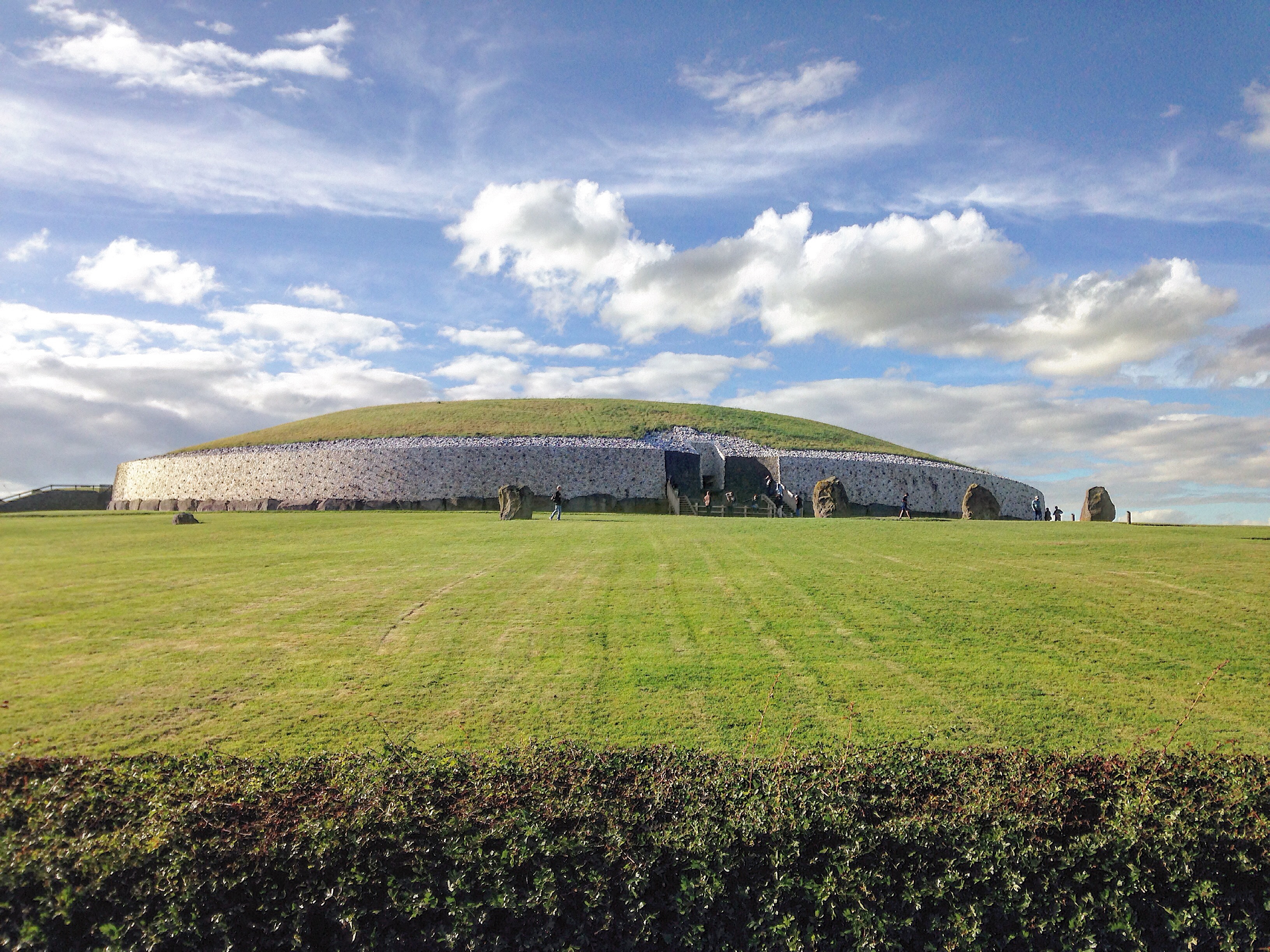
Newgrange
Donore, County Meath, IrelandNeolithic
Mystery rating
Newgrange in Ireland's Boyne Valley is a huge stone and earth mound built around 3200 BC. That is older than the pyramids at Giza. For a few days around the winter solstice, the rising sun shines through a small opening and lights the passage inside.
Why GeisTrack picked it
Newgrange combines verified archaeological precision with layered Irish mythology, from the Tuatha Dé Danann to the god Aengus winning the mound through a riddle about time. It's rare to find a Neolithic site where the engineering claim, a sunbeam reaching a chamber 5,000 years later, is both extraordinary and independently confirmed.
Why it's famous
Newgrange demonstrates a level of astronomical planning that still surprises visitors today. Above its entrance sits a stone opening called a roof-box, positioned so that for a few mornings around the winter solstice, sunlight travels 19 meters down the passage to illuminate the chamber floor. The mound spans 85 meters across, ringed by 97 kerbstones carved with some of Europe's finest Neolithic art, including the famous triple-spiral Entrance Stone. Built around 3200 BC by farming communities near the River Boyne, it required an estimated 200,000 tonnes of material, some of it, including white quartz, hauled more than 70 kilometers from the Wicklow Mountains. The corbelled roof has kept the chamber dry for five millennia without mortar. Rediscovered in 1699 during quarrying, it was excavated by archaeologist Michael J. O'Kelly between 1962 and 1975. In 1967, he became the first person in roughly 5,000 years to see the solstice sunbeam reach the chamber floor.
History
Newgrange was built around 3200 BC by a farming community living in the fertile bend of the River Boyne. To put that into perspective, it was constructed about 500 years before Egypt's Great Pyramid of Giza and a full thousand years before the massive stone circles of Stonehenge. Historians estimate it took an astonishing 200,000 tonnes of material and decades of hard, organized work to complete. The construction shows an incredible level of planning and skill. Workers brought smooth, water-worn quartz and granite cobbles all the way from the Wicklow and Mourne Mountains, over 70 kilometers away. Some of these heavy stones likely traveled by sea and river. The mound is circled by 97 large kerbstones, including the famous Entrance Stone with its distinctive triple spiral, which is one of the most recognizable symbols from prehistoric Europe. Inside, a cross-shaped chamber contains stone basins where cremated human remains were once placed. The passage inside Newgrange is specifically designed to line up with the midwinter sunrise. A special opening above the entrance, called a roof-box, was created just to let that first light in, even when the main entrance would be blocked. Over time, the tomb was sealed up and slowly forgotten. The Romans, who later came to Ireland, left offerings on the mound, and people in medieval Ireland believed it was a home for fairies. The site was rediscovered in 1699 when a local landowner started quarrying it for stone. From 1962 to 1975, archaeologist Michael J. O'Kelly excavated the site. He famously rebuilt the controversial white quartz façade and, in 1967, became the first person in perhaps 5,000 years to witness the solstice sunbeam flood the chamber.
The full story
You can't just drive up to Newgrange. To visit, everyone goes through the Brú na Bóinne Visitor Centre in Donore. Here, you'll get a timed ticket, walk across a footbridge over the Boyne River, and then hop on a shuttle bus that takes you right to the ancient monument. It's a good idea to book your tickets online ahead of time, especially for summer visits or if you want the combo ticket for Knowth, as they often sell out. The guided tour really makes the experience. First, outside, your guide will lead you around the base of the mound to the Entrance Stone. They’ll point out the cool triple spirals and diamond shapes carved into the rock, made with stone tools thousands of years ago. Then, you'll duck inside the passage, which is narrow and pretty low in spots. Huge stones, called orthostats, line the walls, holding up the weight of the mound above. Inside the main chamber, the guide will turn off the lights, letting the darkness sink in completely. Then, they'll recreate the magical solstice moment, showing you how a beam of light would slowly creep across the floor. It's a short, simulated experience, but it's incredibly powerful and something you won't forget. If you want to experience the actual solstice sunrise, you can enter a special lottery. Applications open every autumn, and while tens of thousands apply, only about fifty lucky people get chosen to witness it on the mornings of December 18th-23rd. Even then, Ireland’s famous cloudy weather often means the real sun doesn't make an appearance. Don't miss the chance to buy a combined ticket for Knowth, which is only five minutes away. Knowth has an even larger mound with two passages and holds an incredible amount of ancient artwork – about a third of all known megalithic art in Europe! You can also climb to the top of its mound for amazing views over the entire Boyne Valley. And if you have time, Dowth completes this trio of sites and is free to explore on your own. The wider Boyne Valley is worth a full day of exploration. You can visit the historic Hill of Slane, the ruins of the medieval Mellifont Abbey, the impressive Trim Castle, and the site of the Battle of the Boyne. Newgrange is just 45 minutes from Dublin, making it a perfect day trip from the capital. Try to go early, catch the first shuttle, and be one of the first people to stand inside that incredible chamber before the big tour buses arrive.
Legends & sightings
In ancient Irish mythology, Newgrange, or Brú na Bóinne, was believed to be the home of the Tuatha Dé Danann. These were a race of magical, otherworldly beings who eventually retreated into the mounds of the landscape. Legend says that the site originally belonged to the Dagda, a powerful father god. His son, Aengus Óg, the god of love, won it from him through a clever riddle about time. Aengus asked for the 'brú' for a day and a night, then argued that all days and nights are part of eternity. The chamber is also where the Dagda is said to have fathered Aengus with Boann, the goddess of the Boyne River. To do this, he supposedly halted the sun for nine months, so that Aengus was conceived and born within a single day. This story sounds suspiciously like a mythical memory of how the building itself interacts with sunlight. Later traditions claimed the mound was the burial place for the kings of Tara and even a doorway to the Otherworld, which was best avoided around Samhain (Halloween). The heroic Fenian tales even describe the resurrection of the warrior Diarmuid happening here. Modern visitors often add their own experiences to the site's mystique. When standing in the chamber during the electric-light simulation of the solstice, especially when it's completely dark at first, people often become very quiet and stay that way. The feeling of watching a 5,200-year-old 'machine' still work its magic is truly profound and hard to shake off.
Fact or legend?
Documented: the tomb was built about 5,200 years ago and rediscovered in 1699 after being lost under the mound. The roof box that lets in the solstice sun is original and deliberate. It is a UNESCO World Heritage Site. Debated: exactly how it was used. It held human remains, so it is a tomb, but it was probably also a ceremonial and astronomical site. Legend: Irish mythology links the mound to the Tuatha Dé Danann and the god Dagda. Those are later stories, not the reason it was built.
Field notes
- Newgrange was built around 3200 BC — older than both Stonehenge and the Great Pyramid of Giza.
- The roof-box above the entrance admits the rising sun into the chamber around the winter solstice.
- The corbelled stone roof has kept the chamber waterproof for over 5,000 years without mortar.
- White quartz for the façade was carried more than 70 km from the Wicklow Mountains.
- The Entrance Stone's triple spiral is one of the most famous images in prehistoric European art.
- Places to witness the actual solstice sunrise inside the chamber are allocated by public lottery each year.
Our verdict
GeisTrack Verdict
Newgrange is worth the visit even without the solstice event, which very few travellers will ever see in person; the lottery accepts tens of thousands of applications for around fifty spots, and Irish weather often hides the sun anyway. The guided tour includes a simulated light show inside the chamber that's genuinely effective, and the carved kerbstones outside are worth lingering over. Access requires a timed shuttle from the visitor center, so book ahead, especially in summer. Pair it with nearby Knowth, which holds even more megalithic art, for a fuller day. This suits history and archaeology fans more than thrill-seekers; the mystery here is engineering, not the supernatural.
Editorial assessment based on research, not a sponsored review. See our editorial policy.
Can you visit?
Yes, but only through the visitor centre. All visits to Newgrange start at Brú na Bóinne Visitor Centre and continue by shuttle bus with a guide. You cannot drive to the mound or walk in unaccompanied. Places are limited, so book online. Entry for the solstice sunrise itself is decided by a public lottery each year.
How to get there
1. Fly into Dublin (DUB). 2. Drive north towards Drogheda, roughly 45 minutes to an hour, or take a train or bus to Drogheda. 3. Follow signs to Brú na Bóinne Visitor Centre near Donore. From Drogheda you will need a taxi or tour bus. 4. From the centre, the official shuttle takes you to the monument. Organised day tours from Dublin are a common and easy option.
Before you go
Book timed tickets online in advance. Tours sell out, especially in summer. Allow three hours minimum for the centre and the guided visit. The passage is narrow and low, so it is difficult if you dislike enclosed spaces. Bring rain gear. This is Ireland and the walk is outdoors. Enter the solstice lottery months ahead if you want the real sunrise.
Travel tips
Make sure to book your timed tickets online well in advance and try to get on one of the earliest shuttles. It's a good idea to buy the combined Newgrange and Knowth ticket. Dress warmly, especially for wind, as the Boyne Valley can be quite exposed. Wear shoes with good grip, as the passage inside can be damp. If you're planning a trip in December and hope to see the solstice, remember to enter the lottery in the autumn.
Safety
You can only access Newgrange via a timed shuttle bus from the visitor center. You are not allowed to drive directly to the mound itself.
What to expect
The exhibition at the centre comes first, then a short bus ride and a walk up to a bright white quartz wall and a mound bigger than photos suggest. Inside, you shuffle along a narrow passage into a stone chamber where the guide simulates the solstice light. It is quiet, cold and genuinely impressive. Around two hours in total.
Visit with respect
Human remains were placed here. Do not touch the carved kerbstones and stay with your guide at all times.
Frequently asked
Plan your trip
Book the practical parts of the journey. We may earn a commission from these partner links, at no extra cost to you.
Plan your visit
Getting to Newgrange
Everything you need to turn this mystery into a trip. We may earn a commission from these partner links, at no extra cost to you.
- Best time to visit
- April to October is generally best for tours. December is the only time for the actual solstice experience, if you're lucky enough to win the lottery.
- Opening hours
- Visitor centre 09:00–18:30 summer, shorter in winter
- Entrance fee
- Approx. EUR 18 including shuttle
Continue your GeisTrack
Other places on GeisTrack that pair well with Newgrange — same kind of story, or the same corner of the map.
Make it a route
The Boyne Valley makes a full route: Newgrange, Knowth, the Hill of Tara and Trim Castle.
Turkey
Göbekli Tepe
Göbekli Tepe in southeast Turkey is a set of stone circles built around 9500 BC. That makes it thousands of years older than Stonehenge or the pyramids, and older than farming, pottery or writing in this region. Hunter gatherers carved and raised T shaped pillars up to 5.5 metres tall.
United Kingdom
Stonehenge
Stonehenge stands on Salisbury Plain in southern England. Building started around 3000 BC and the big stone circle went up a few hundred years later. Some of the stones were dragged here from Wales, roughly 250 km away. Nobody knows exactly why.
Or browse every ancient mysteries entry, or open the interactive atlas.
Read the story
Long-form journal writing about Newgrange.
Rate This Destination
What do you think of this destination? Share your rating with the GeisTrack community.
Community Rating
No ratings yet. Be the first to rate this destination.
Visitor opinion only — separate from the GeisTrack editorial mystery ratings above.
Been here? Share your experience
Have you visited this place? Tell other GeisTrack travelers what it was really like. Your experience may help someone plan their own visit.
No comments yet
No traveler comments yet. Be the first to share your thoughts.